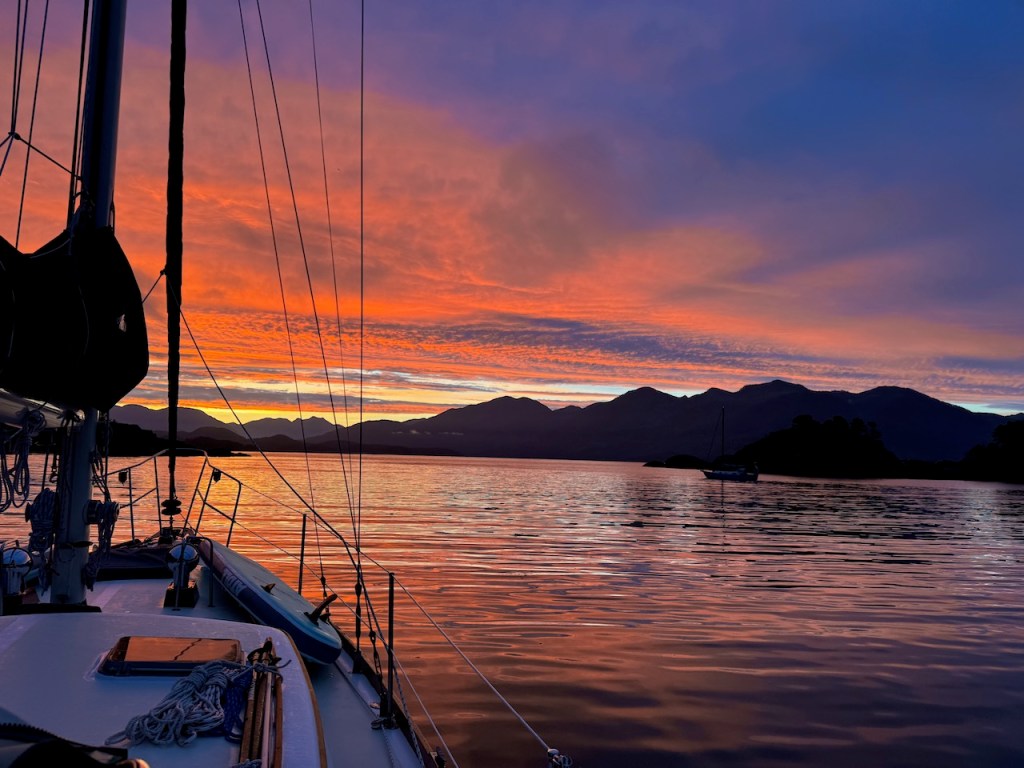
It’s Wednesday, August 6 and we are at Westview Marina in Tahsis, BC. When I say we are at a marina, it’s not the kind you may first think of—tidy, well-kept, an aroma of money—these west coast marinas are small and roughhewn with an aroma more like dead fish. The docks list one way then the other. Tripping hazards are many.
Sport fishing is the big draw along Vancouver’s west coast and that’s the market the marinas here cater to. There are numerous outfitters and high-end fishing camps, too. Fishermen—and it’s almost all men—pull the largest boats they can trailer down miles of dirt roads to get to some of these inlets. And it’s worth it—the fishing here does not disappoint—we’ve seen fishermen come in with huge salmon, halibut, cod, and others. These small marinas provide fish cleaning stations and plenty of beer. Most can connect their customers to businesses that process, quick-freeze, and pack fish for transport.
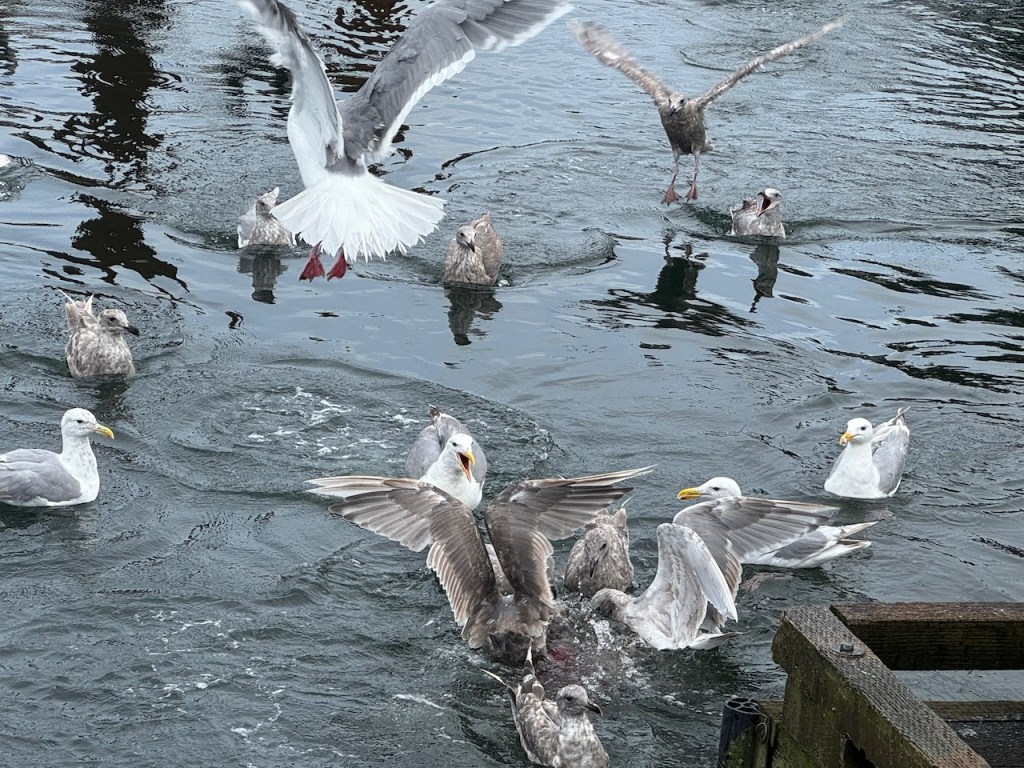
Westview collects all the heads and guts and puts them out on the end of their log breakwater for the birds. Eagles, vultures, ravens, crows, gulls, and others feast in turn, with the eagles always getting first dibs. It’s smelly, but the birds sure appreciate it, especially during the lean summer months when the fish go deep and it’s harder for them to get enough to eat.
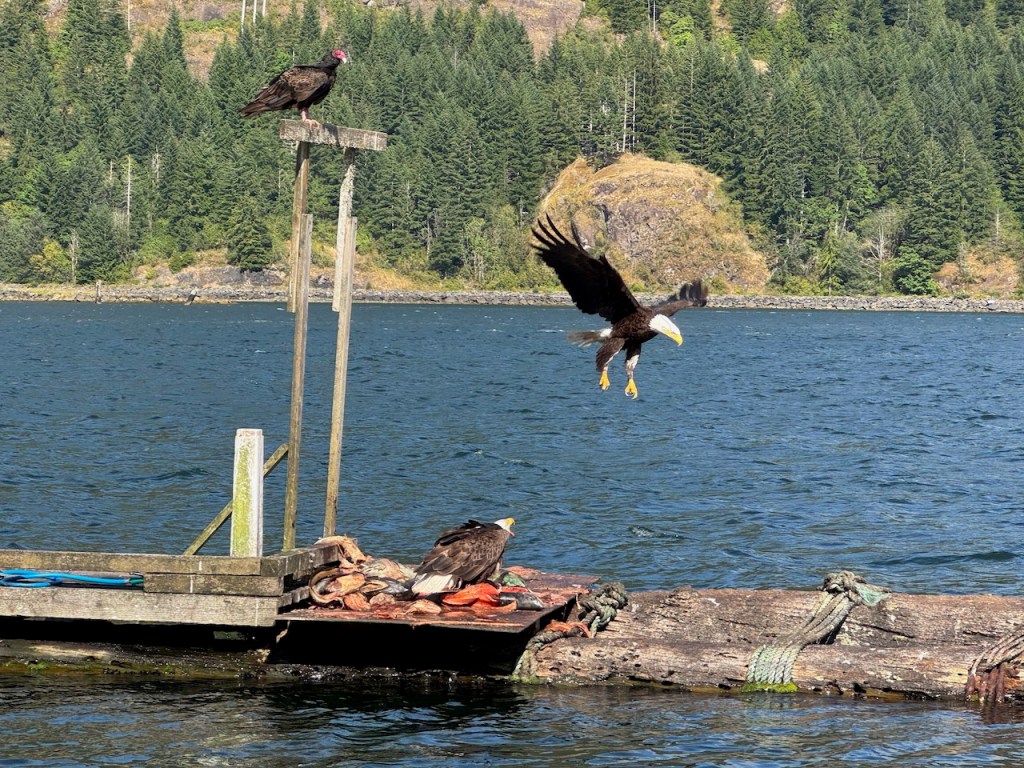
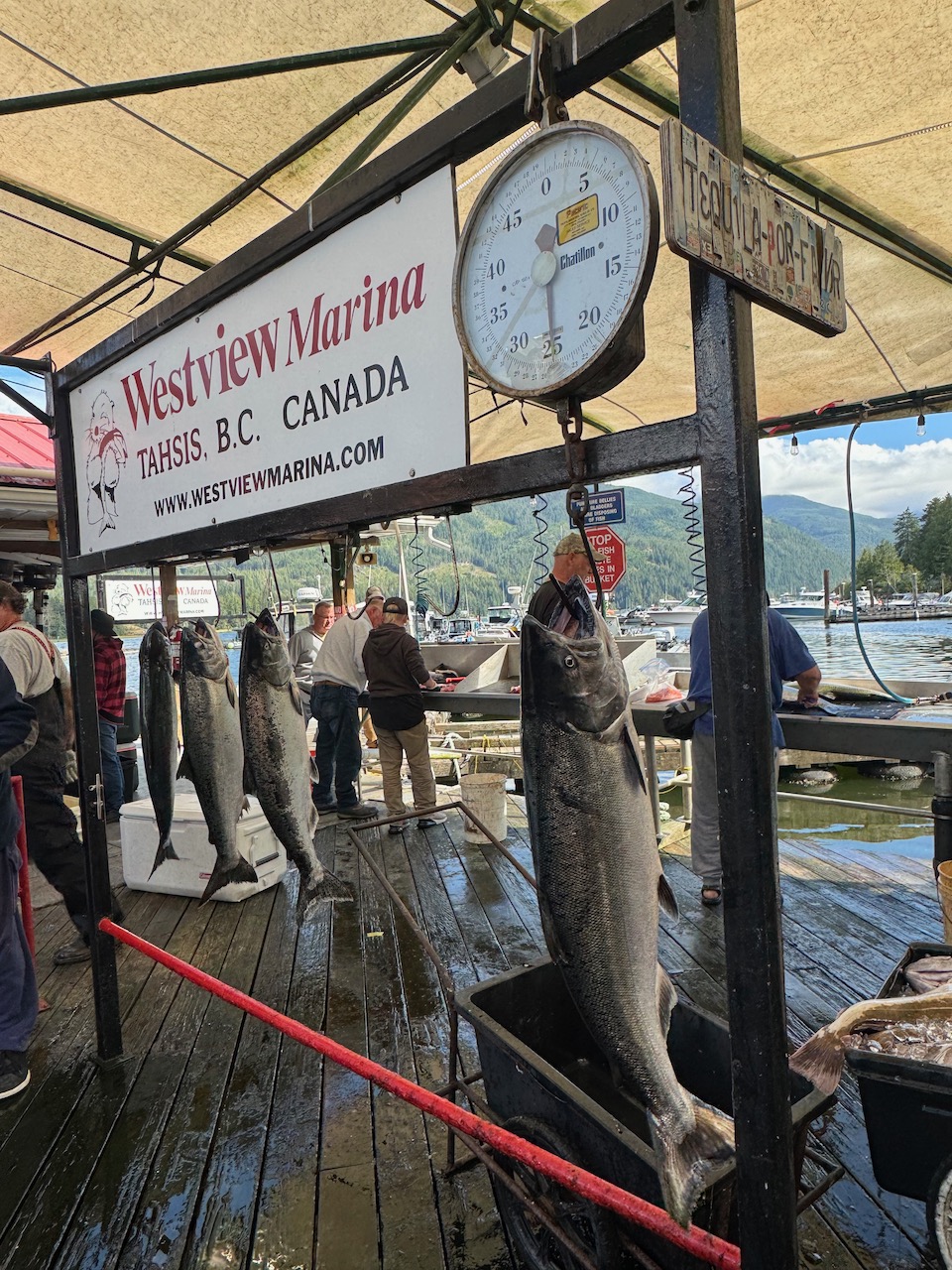
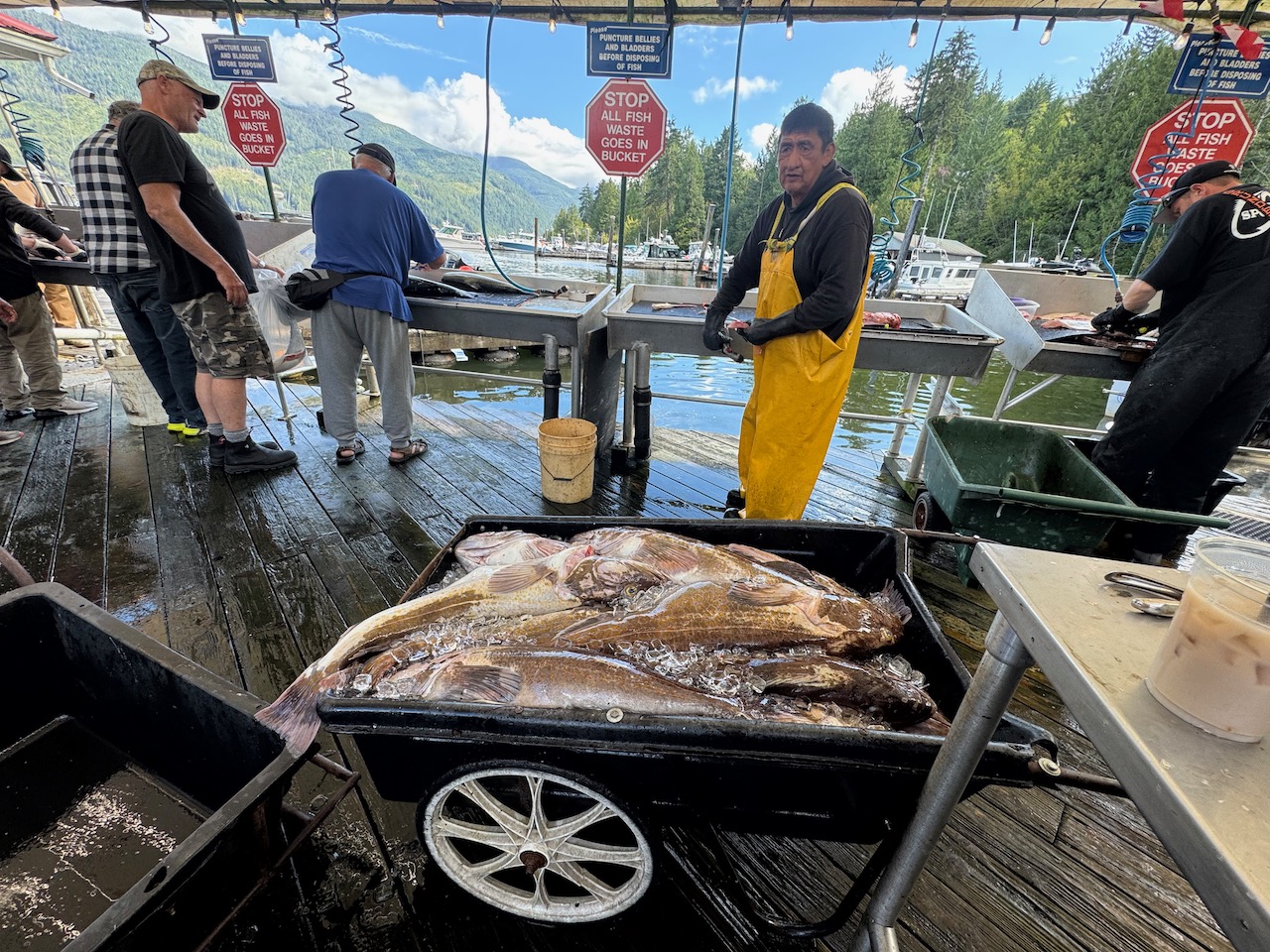
Fishermen clean their catch at Westview Marina after a successful day.
We’ve been on the move this past week and it’s been glorious. After our tsunami scare, we took advantage of a beautiful, calm day to make our next offshore passage to Kyuquot Sound. Most cruisers go to Walter’s Cove first, a place where the cruising guides tell us we can pick up provisions. But the guide books say that the store is restocked on Fridays—after the Uchuck III comes in and unloads its cargo. It was Wednesday, so we tuck into Dixie Cove with a plan to return to Walter’s Cove in a couple of days. What Dixie Cove lacks in character is more than made up for with how secure we feel after our crazy night before. Bowl shaped, beautiful, and completely protected, it’s a place to get a good night’s sleep in any conditions and that’s exactly what we did.
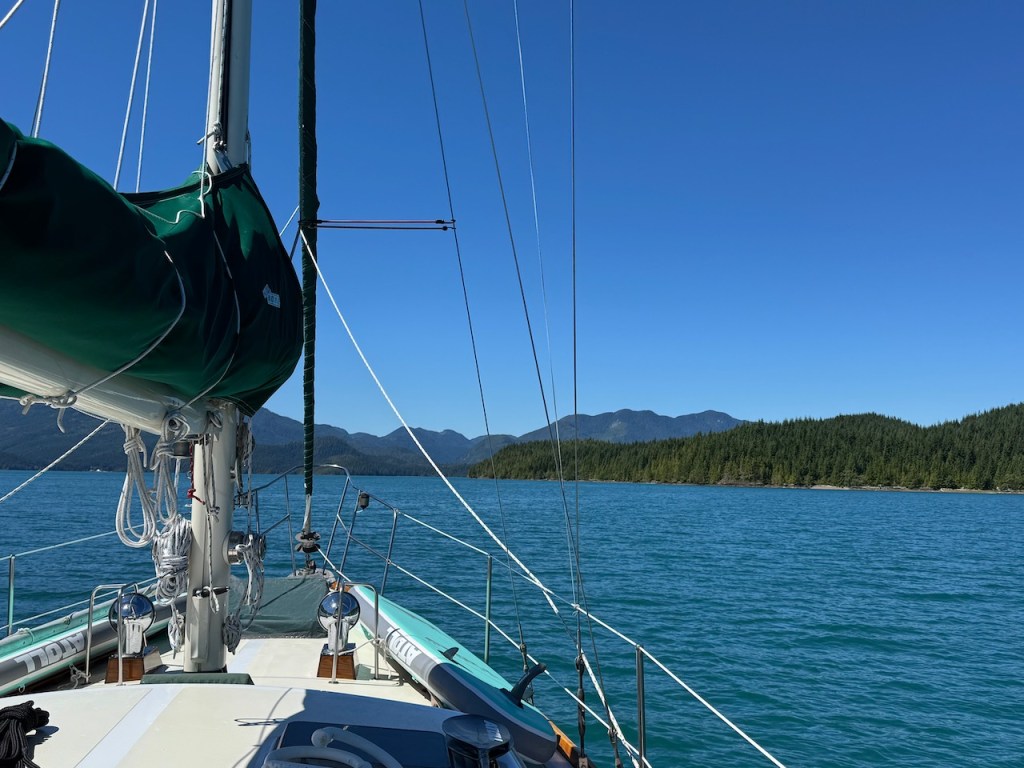
On Thursday we head for a quick stop at Fair Harbor—which is not much more than a gas dock with a small store—where we can fuel up and refill drinking water. We don’t expect much from the store, but the owner has just returned from a supply run. We’d only stopped in for an ice cream, but I’m grabbing grapes, spinach, and lettuce, and any other produce I can find along with eggs, cream, bread. I’ve learned on this trip to get what you can when you can, and it was a good thing I did.
From Fair Harbor we work deeper into Kyuquot Sound to anchor in secluded and peaceful Hankin Cove. It is a gloriously warm and sunny day and we are completely alone. Off come our clothes for a giddy naked afternoon on the boat. Such freedom! Sorry, no pictures.
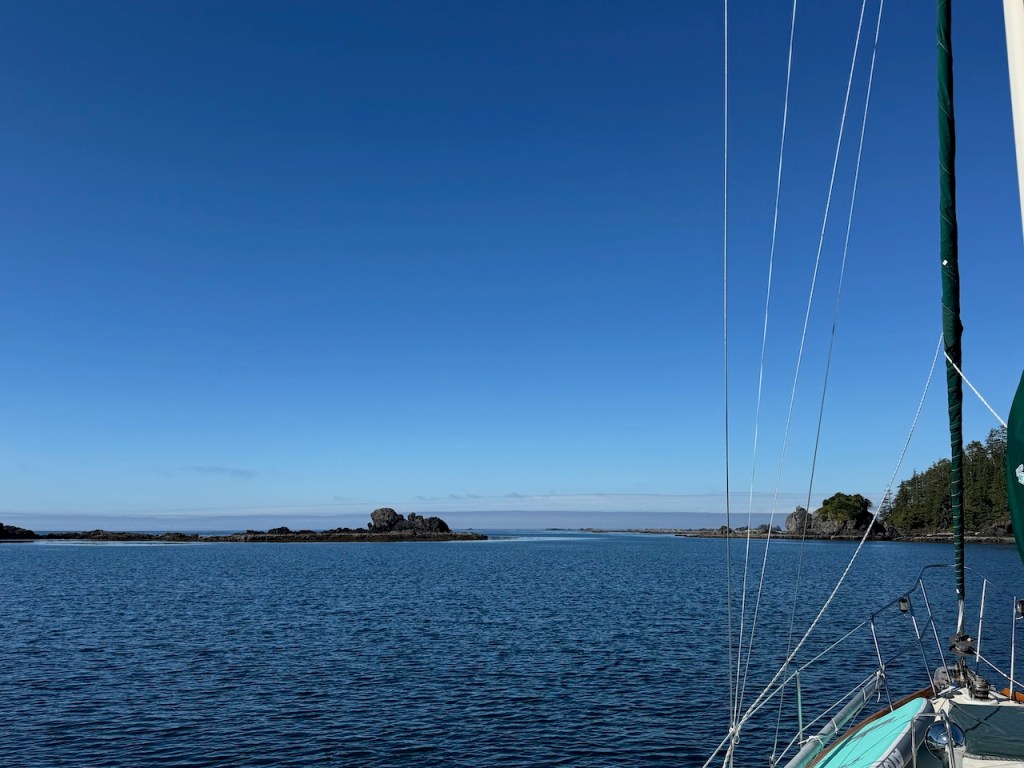
Friday arrives and we make our way back to the coast winding through a maze of rocks, islets, and shoals to enter Walter’s Cove and the First Nation community of Kyuquot. It’s still early, so we moor on the public dock and have a chance to explore before the store opens at 1 PM.
Up at the top of the pier is the store/post office, and a small handmade sign pointing down a dirt path that says “Outpost Cafe, 1 KM.” We’ve read about this remote little restaurant and follow the path as it winds through tidy front yards and then a stand of massive old-growth spruce. We continue on, now through the backyards of modest waterfront homes only accessible by this narrow path or by boat. We come upon a back porch loaded with what we later learn is 400 pounds of potatoes, and around the side is an entrance to the small café. It does not open until 4:30, but the personable owner Eric invites us in for a look. Various versions of wings, burgers, fries, and salads are on the menu, which seems to be standard West Coast fare. We ask, ‘Why no fish and chips?’ Eric explains that he is not allowed to buy fish off the dock or from the local first nations residents. He must buy it from an approved supplier in Vancouver, which costs four times as much. If he doesn’t, he’s subject to a $50,000 fine. It’s just not a risk he’s willing to take. Most of his customers are the locals who live in Kyuquot across the bay who are not going to pay for government certified fish and chips. We promise to come back later for dinner.
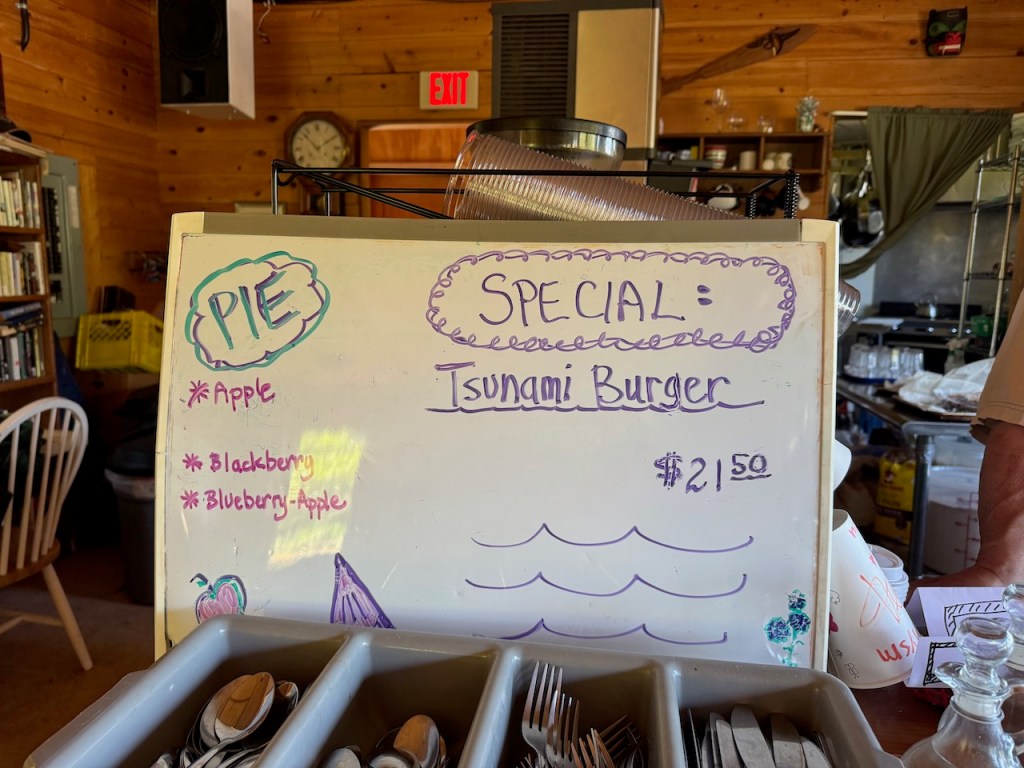
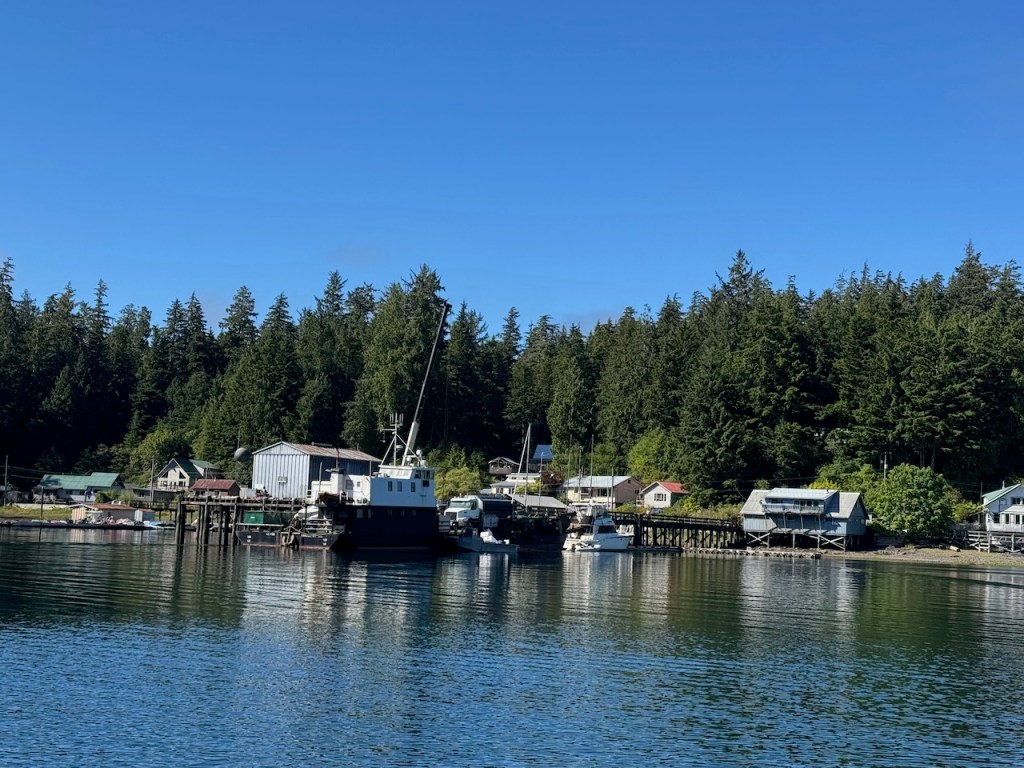
The special at Outpost Cafe; The public dock at Walter’s Cove.
On the way back to the dock we take a fork in the path through more gargantuan trees to a small driftwood-strewn rocky beach. Beach combing is one of our favorite activities and this one is dotted with small glowing gems of beach glass—the first ones we’ve come across.
At 1 PM we head to the store to see what we can find. The Friday restock is a myth, we discover. They restock when they drive to Campbell River on the other side of Vancouver Island and when that happens varies. As it turns out, this is the Friday before Canada’s summer long weekend. Most stores would stock up. Here, she decided she wants to make sure she sells everything before she is closed on Monday so the shelves are almost bare. We leave with their last three small, tired tomatoes and a bottle of vinegar. That’s it for our planned big provisioning stop.
With plenty of time before dinner we walk the other way along the small path through more front yards of summer homes and destination fishing lodges. The path ends at a point. It’s low tide so we head down to the rocks and around the corner to discover a beautiful sea stack. It was another banner day and dinner at the Outpost with fellow cruisers Tom and Jandira was delightful and delicious. And we got our steps in—over 12,000 that day!
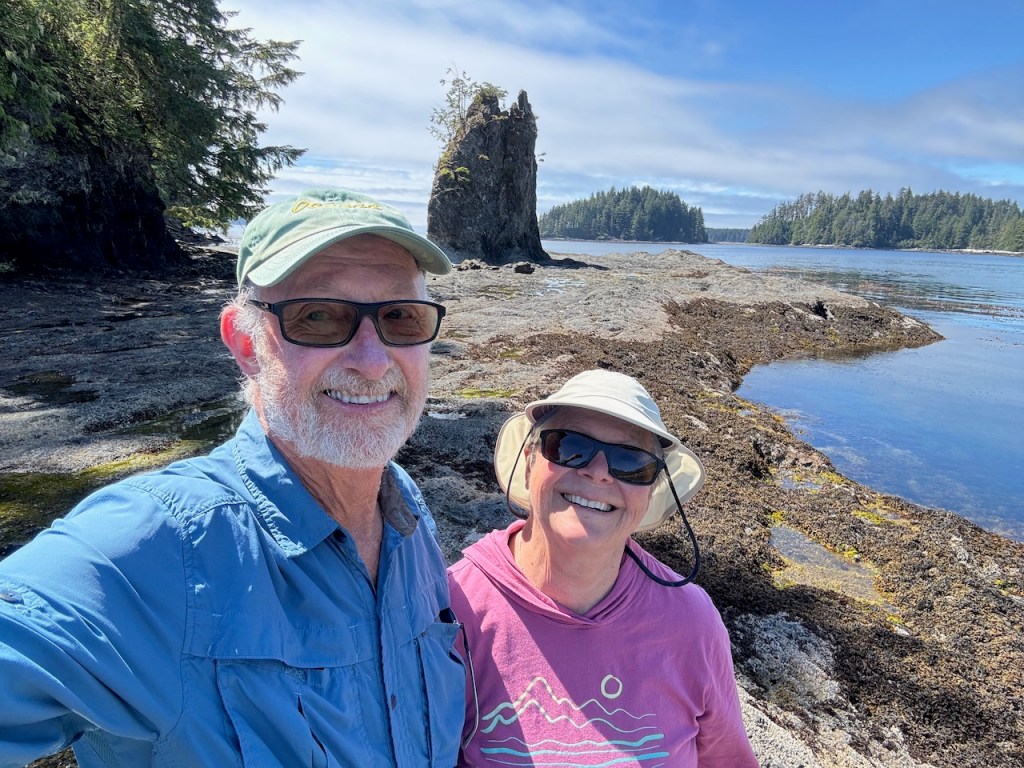
Beautiful seastack at Walter’s Cove
The next day we head to Rugged Point Marine Park with claims of having some of the best sandy beaches on Vancouver Island. We anchor outside the smaller inner-cove beach and dinghy to shore to hike a short distance through forest to the Pacific side for a wonderful day-long beach expedition. The guidebooks warn to anchor there with caution because the area is subject to “strong outflow winds” that build at night and can last through the morning hours. We’d arrived in the morning and it was calm and glassy as it has been for days. We weren’t worried. We didn’t see any outflow winds forecast and it was still calm when we went to bed.
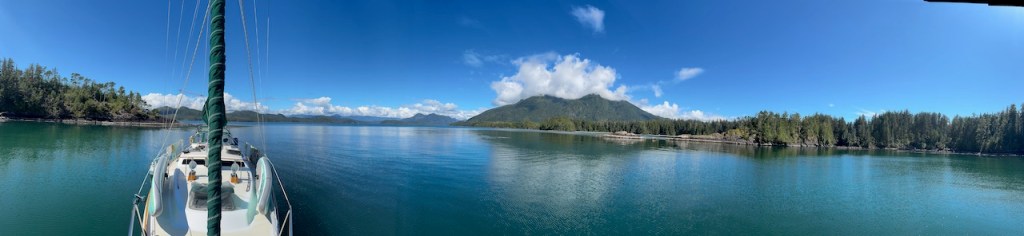
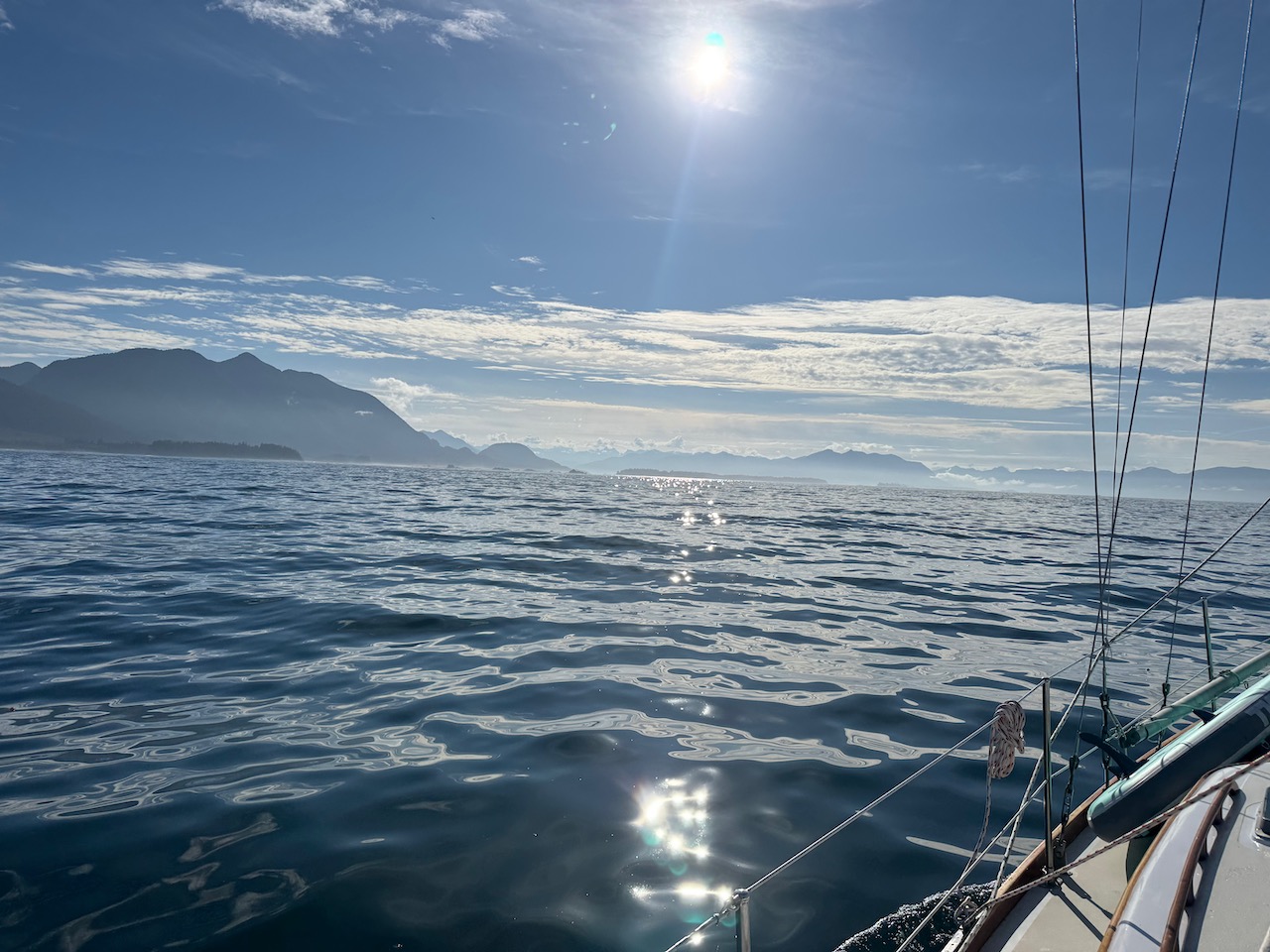
The view from our bowsprit of our then-calm anchorage at Rugged Point.
I slept like a baby that night—David did not.
Indeed, strong outflow winds had continued to build overnight, blowing us toward the shallows and rocky shore. David was up checking our position hourly, making sure our anchor did not drag and that we weren’t blown into the shallows and rocks. When I finally raise my sleepy head, I could see that we were shallow and close to shore, but okay. We quickly raise anchor and headed around the point into the vast Pacific, where it is as calm as can be.
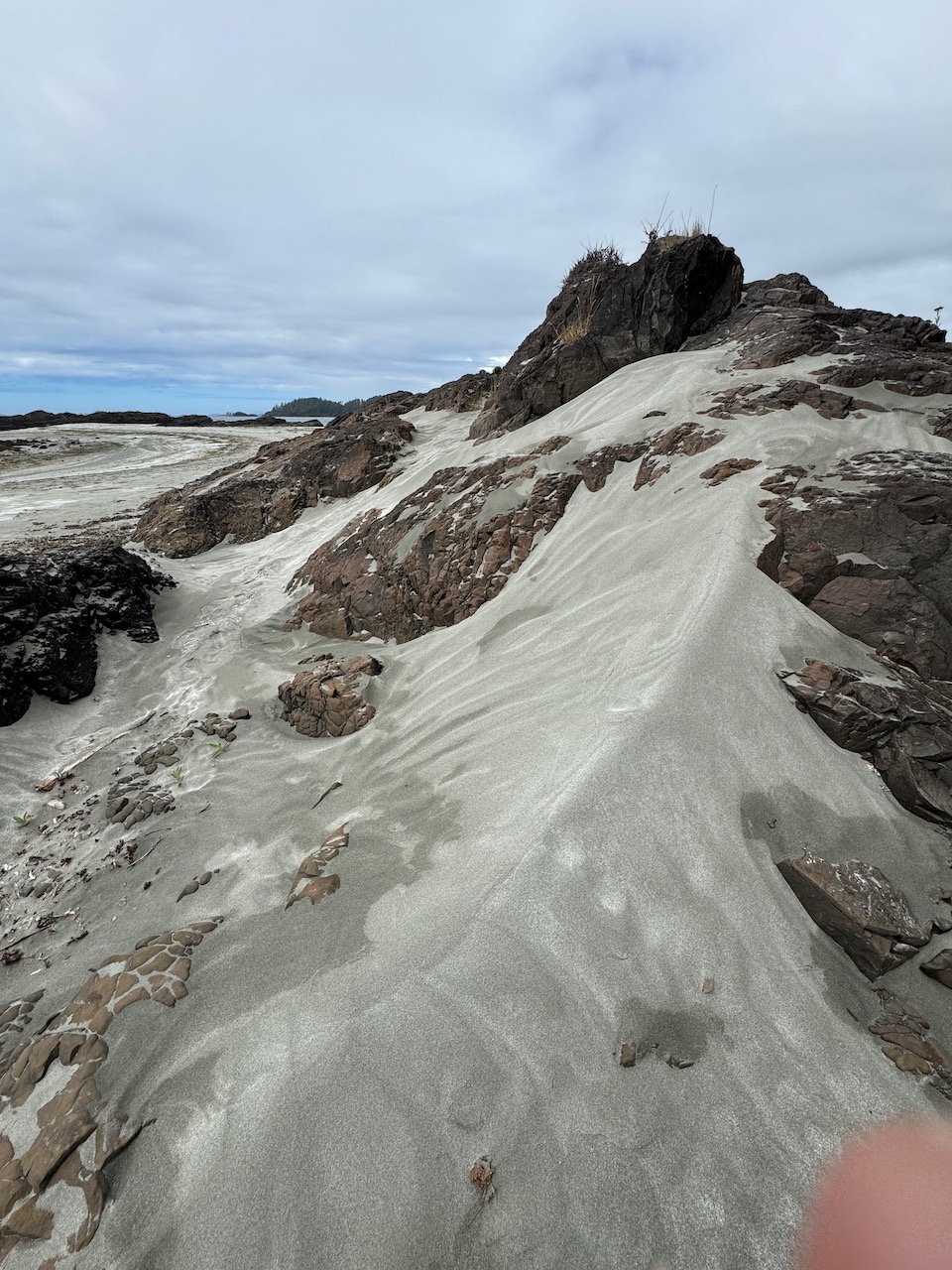
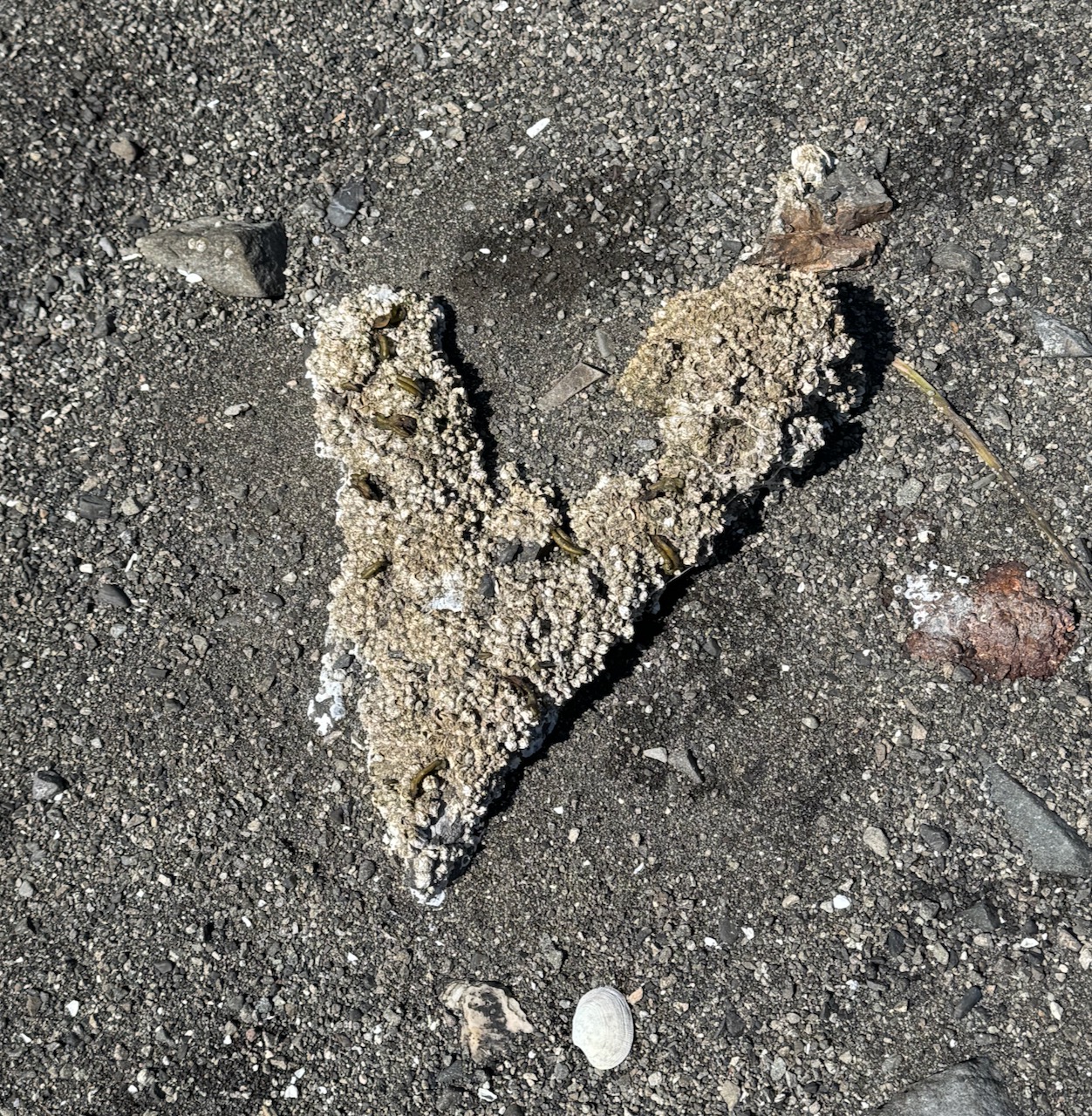
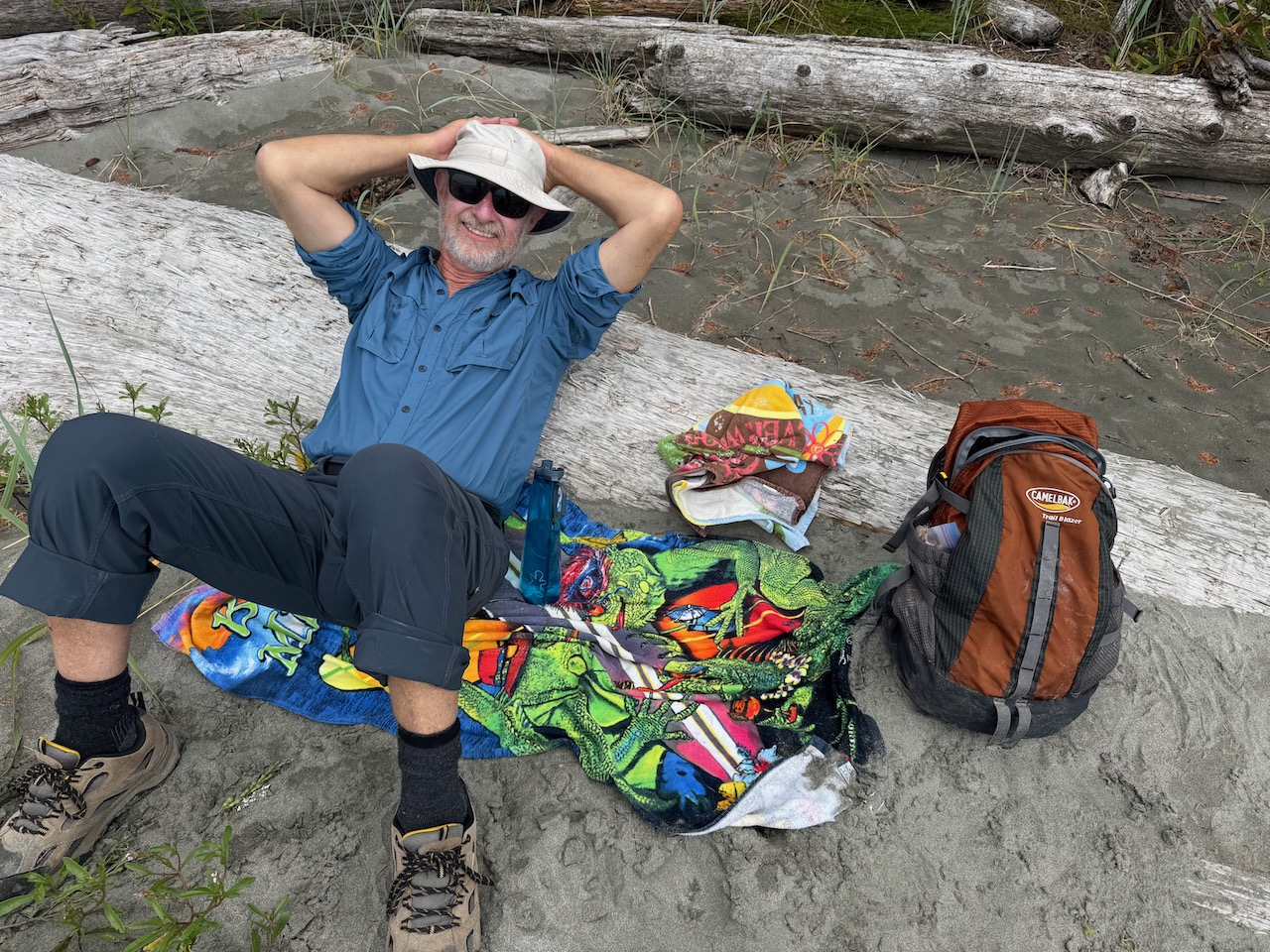
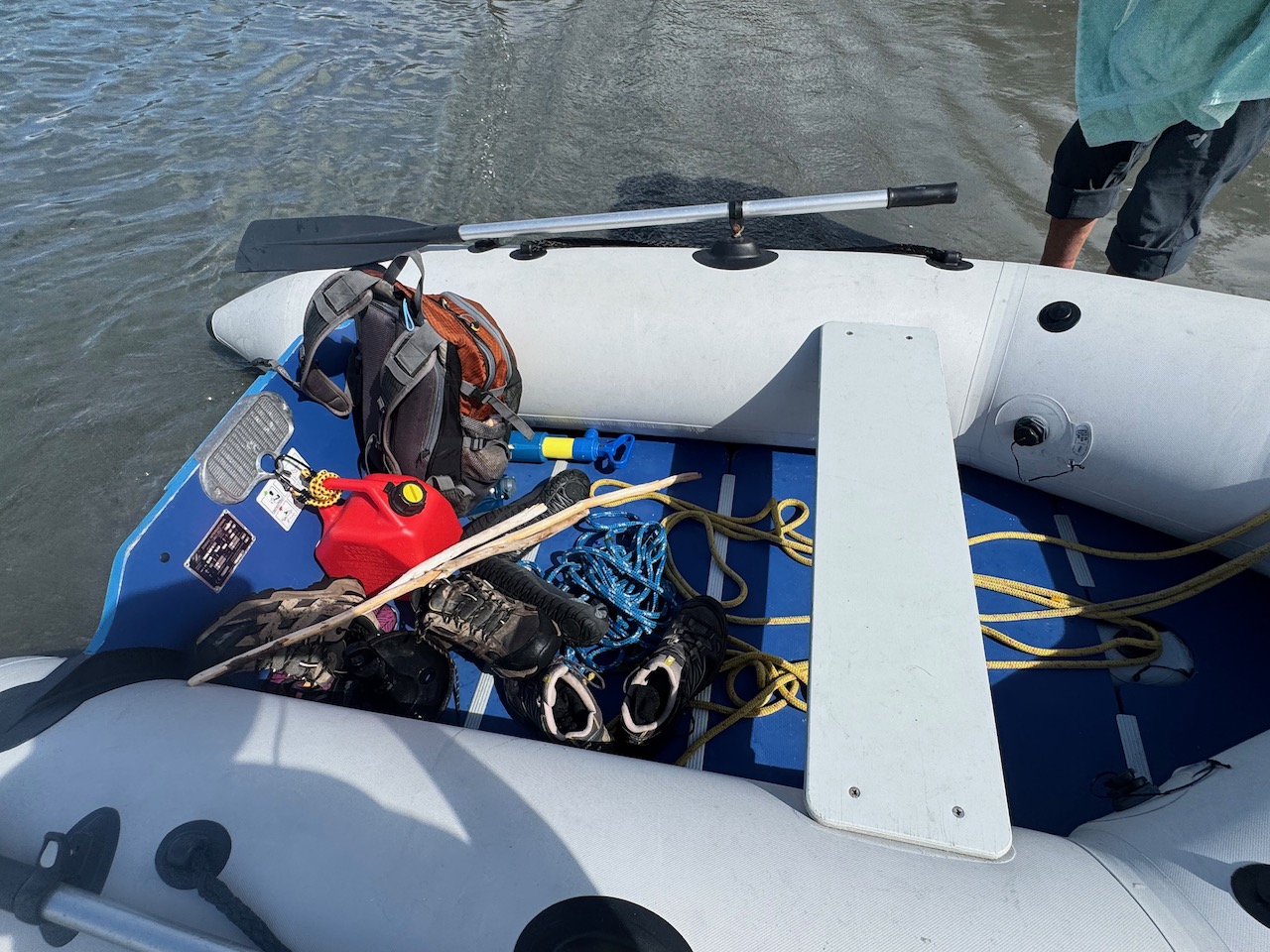
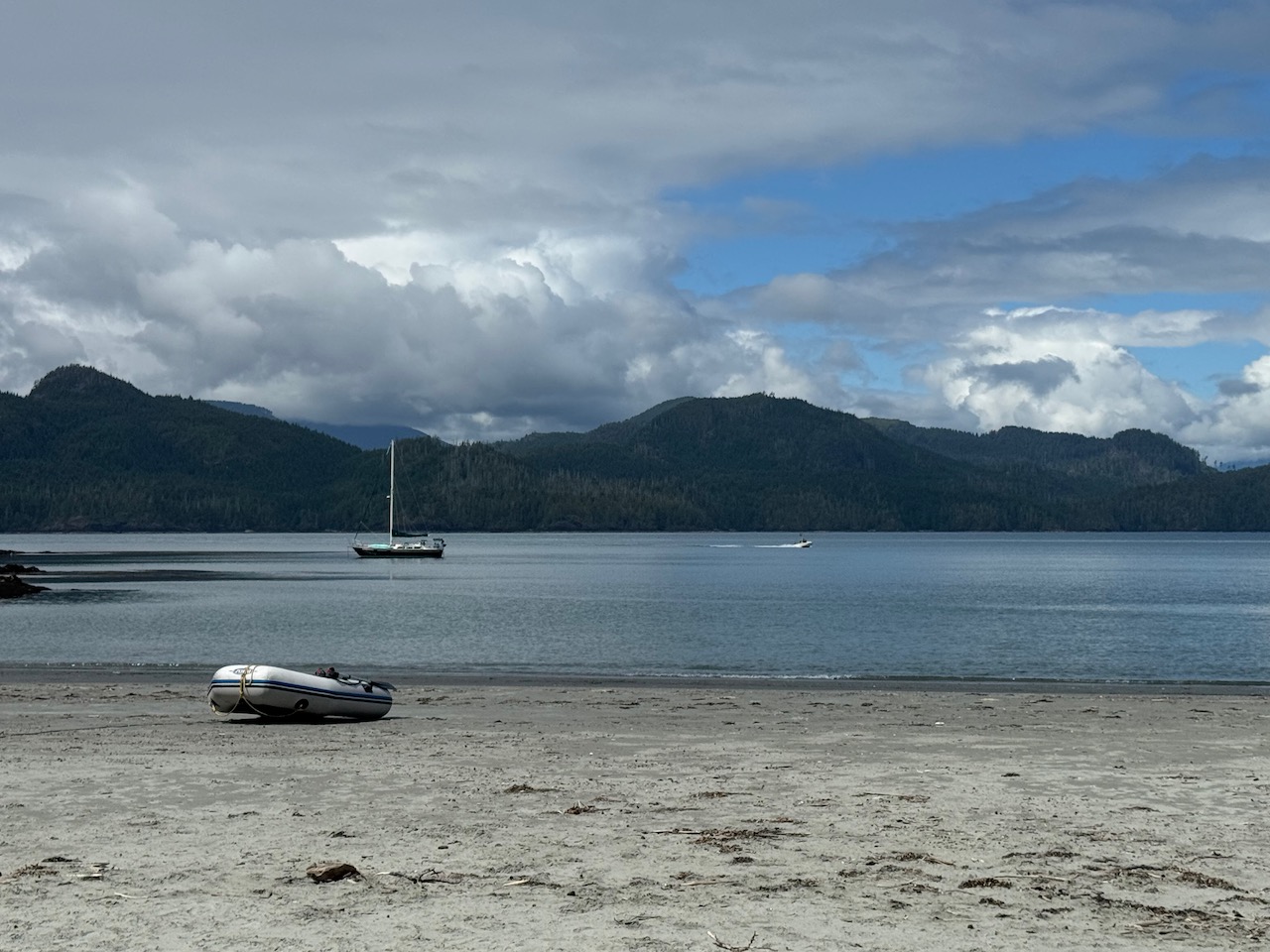
We dingy over ready to explore the Pacific Coast side of Rugged Point.
Our fourth offshore passage takes us to Esperanza Inlet and Nuchatlitz Marine Park—the former summer village site of the Nuchatlaht First Nation and a destination we’ve been looking forward to. The entrance to the anchorage winds through shoals and rocks and the innermost extremely narrow channel is marked with buoys. From the site of the original village we hike along an isthmus to the adjoining island that’s supposed to have two trails around rocky headlands to aid complete circumnavigation of the island. We found one of the primitive trails but not the other and had to scramble over one set of jagged headland rocks. We weren’t the only ones on exploring the island that day. A group of kayakers had landed and were setting up for the night when they discovered the picked-over bones of a sea otter nearby. Later, we came upon fresh tracks of two wolves in the sand. I’m sure they saw us, but we never saw them.
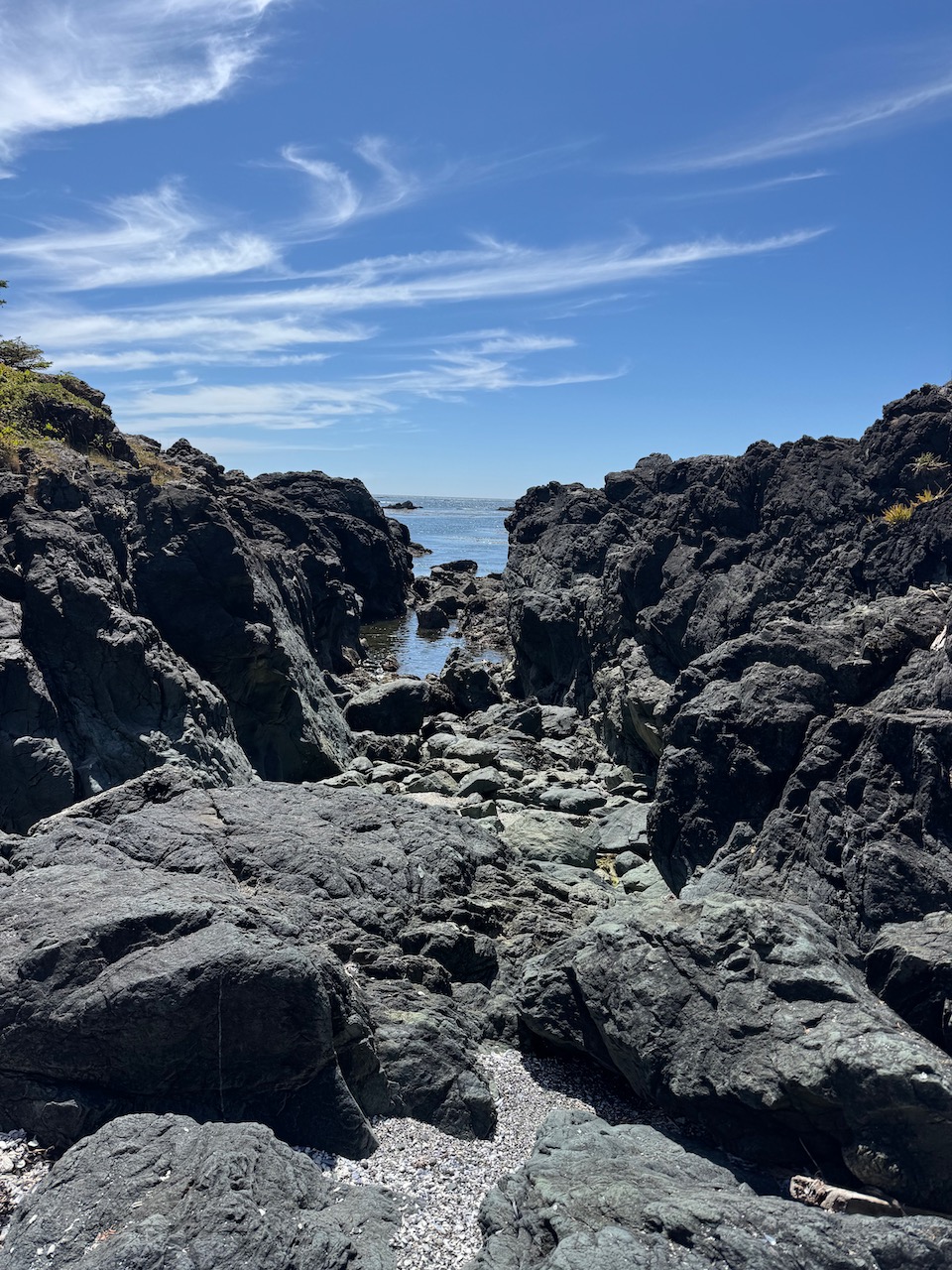

After a calm ocean passing we explore Nuchatlitz, coming across fresh wolf tracks in the sand.
With a gale in the forecast, we have a wonderful day sailing the full twenty miles up the Inlet to the tiny town of Zeballos. Zeballos was a bustling community in it’s goldmining heyday. But like most economies built on natural resources, its time has long passed. It’s doing its best to revitalize and there is certainly some community pride in its history. The setting is spectacular—at the end of a fjord with steep mountains rising on every side. It is the end of the road in both respects, by land and by water. The small public dock was filled with small sports-fishing boats, and it has a much different vibe than Tahsis. Most cruisers skip it. But I believe they have an opportunity to compete with Tahsis and I’m glad we detoured to go there.
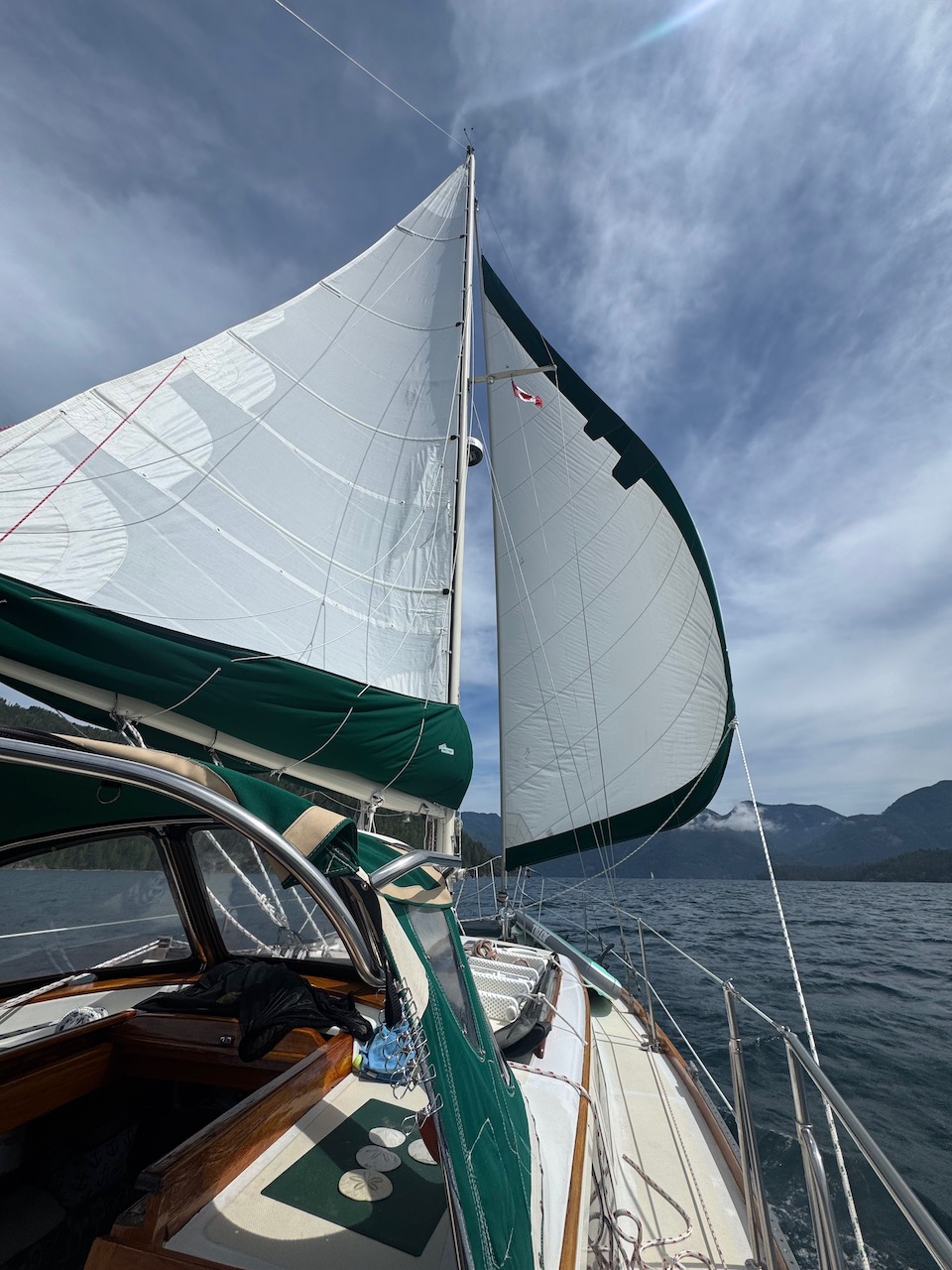
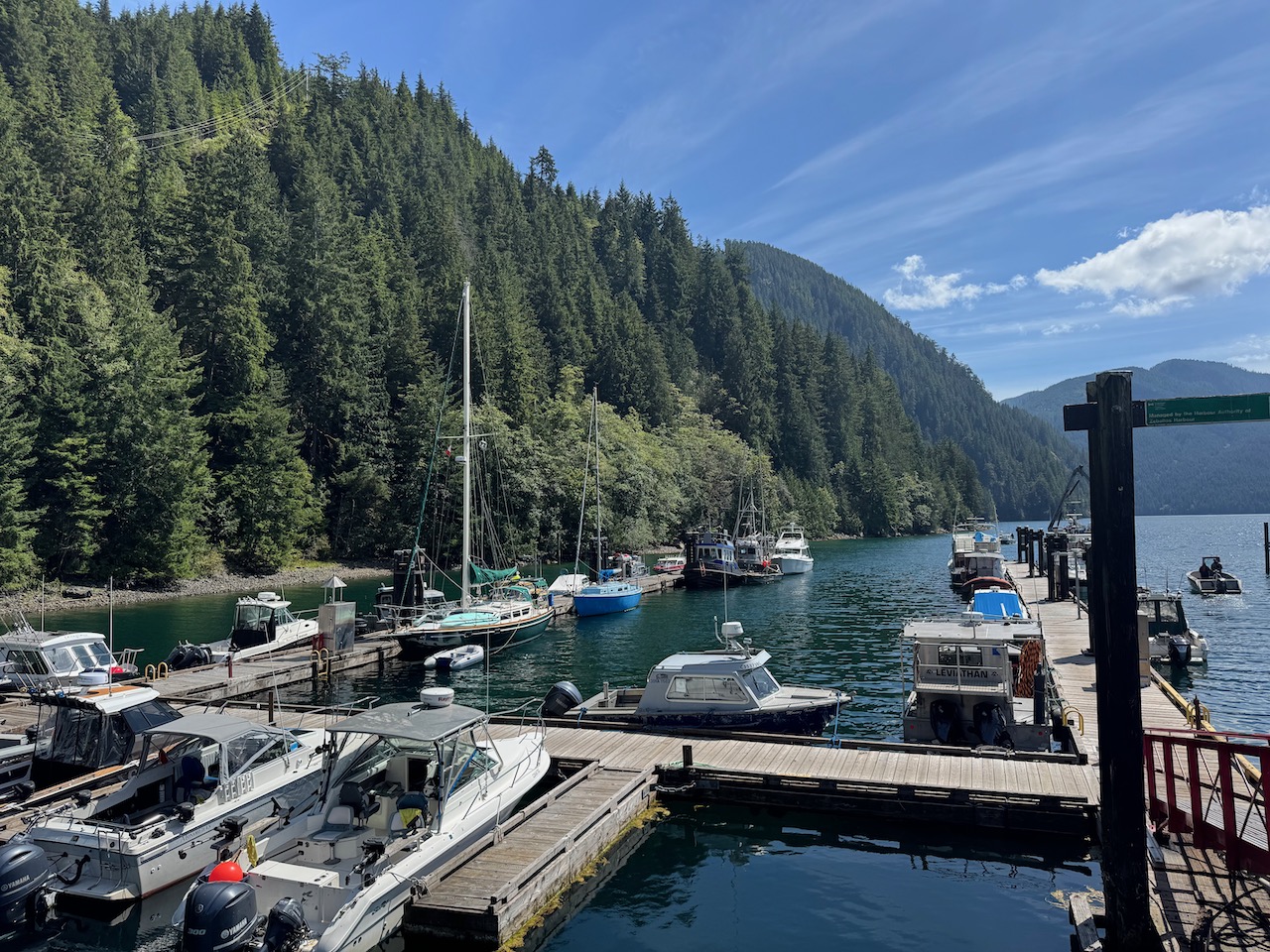
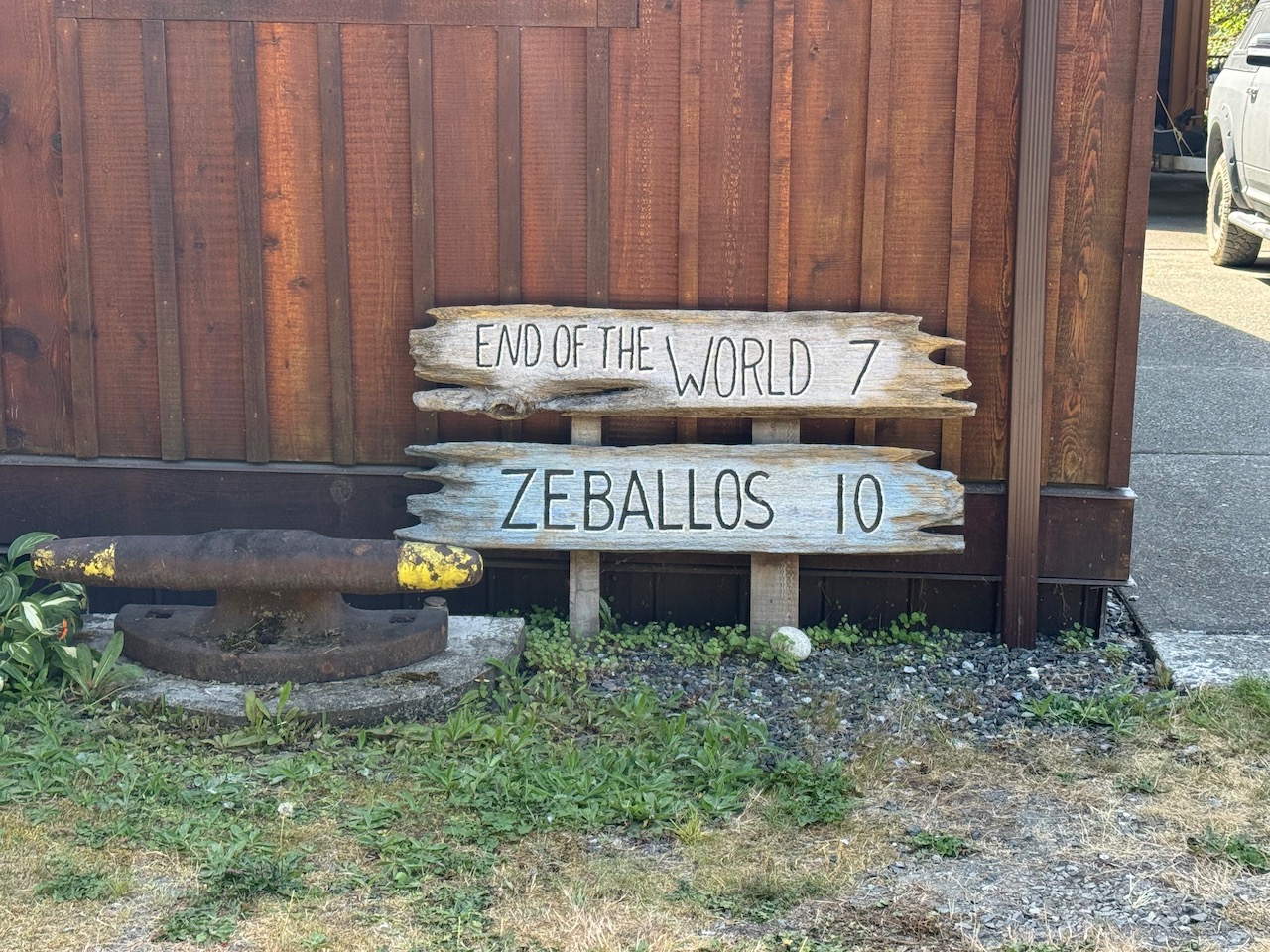
A perfect sail leads us to the village of Zeballos, the end of the road in all respects.
It’s raining when we head from Zeballos to Tahsis—much needed rain. It turns out to be a good day to tuck in and do laundry. This is the first washer and dryer we’ve come across in almost three weeks. There are only two functioning washers and one functioning dryer at the marina and two other sailboats at the dock with weeks’ worth of laundry. It takes us hours and hours. But we sleep on clean sheets in clean pjs that night and we’ve had a hot shower. Ahhh…deep pleasure out of the simplest things.
It’s now Friday, August 8. You’d think I’d have plenty of time to finish a blog post in a day. But our days are full and in the evening I’m toast. On the 6th I’d laid aside my writing so we could see if we could find a coffee roaster and bakery, we’d heard was a 10 minute walk from the marina. It had finally stopped raining and we really needed to stretch our legs. We were absolutely delighted to find Coal Creek Roasters—the nicest place with the best coffee and baked goods we’ve been to in weeks!! Fresh, hot from the oven artesian sourdough bread! We bought two loaves along with pastries and coffee and settle into Jan’s delightful space. We return the next morning for breakfast before heading down the fjord 20 miles to the coast.
We anchor in Friendly Cove, in Nootka Sound. Friendly Cove and the Village of Yuquoat was settled at least 4,300 years ago and has significant historical significance to British Columbia and Vancouver Island. I highly recommend that you read about it here.
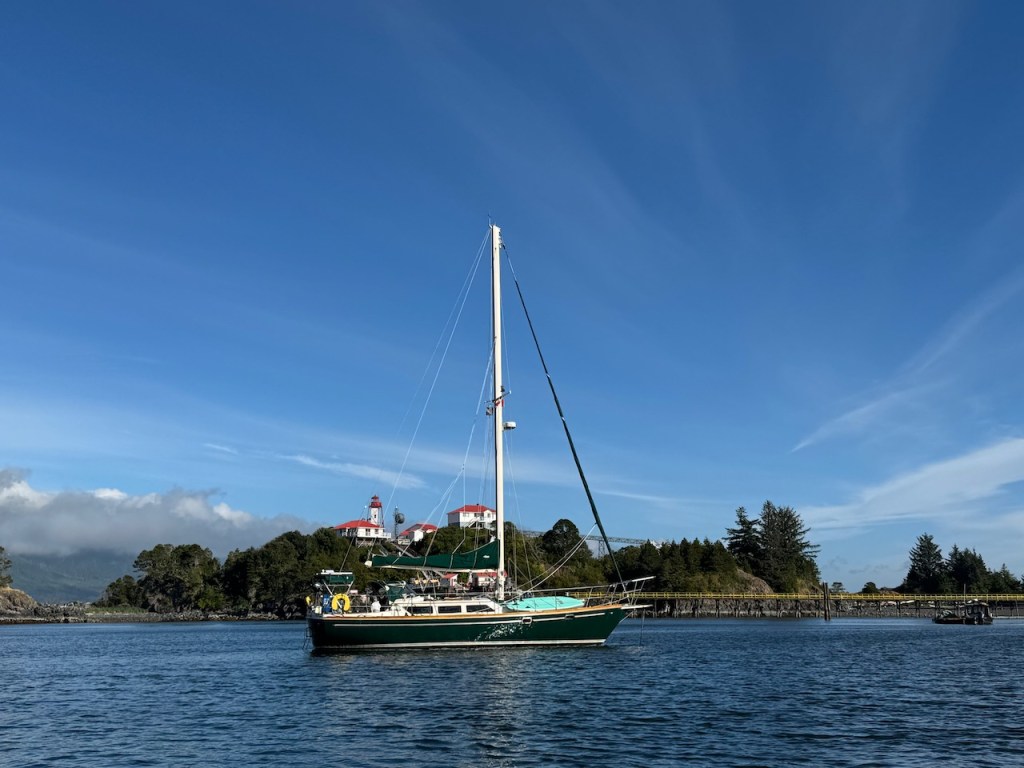
Once a huge and vibrant native community of 1500 or more, only four members of the First Nation Williams family reside on the island year-round. Master carver Sanford Williams grew up here—when he wasn’t at the abusive residential school—and maintains a summer carving studio here. We are delighted to meet him in his studio, and chat and watch this world-renowned carver work on a totem.
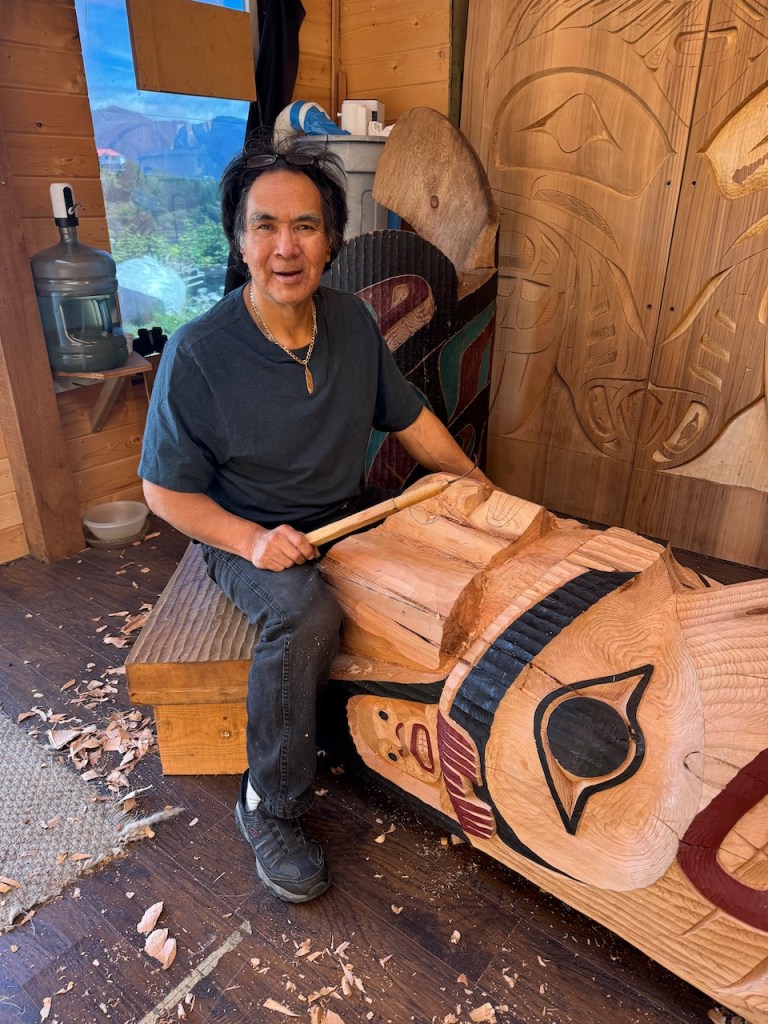
Master Carver Sanford Williams working in his studio in Yuquoat..
We arrived during the annual Summerfest gathering when hundreds of Mowachaht/Muchalahat people return to their homeland to camp, feast, and celebrate. Not wanting to intrude we skirt their camp to see the historic village church-museum full of resplendent North Coast carvings from a former master carver. Then we climb the steps to the beautiful Nootka Lighthouse from where fellow cruisers had texted us during the tsunami scare, as they looked down at their boat anchored in the bay. Now we were looking down at our own boat.
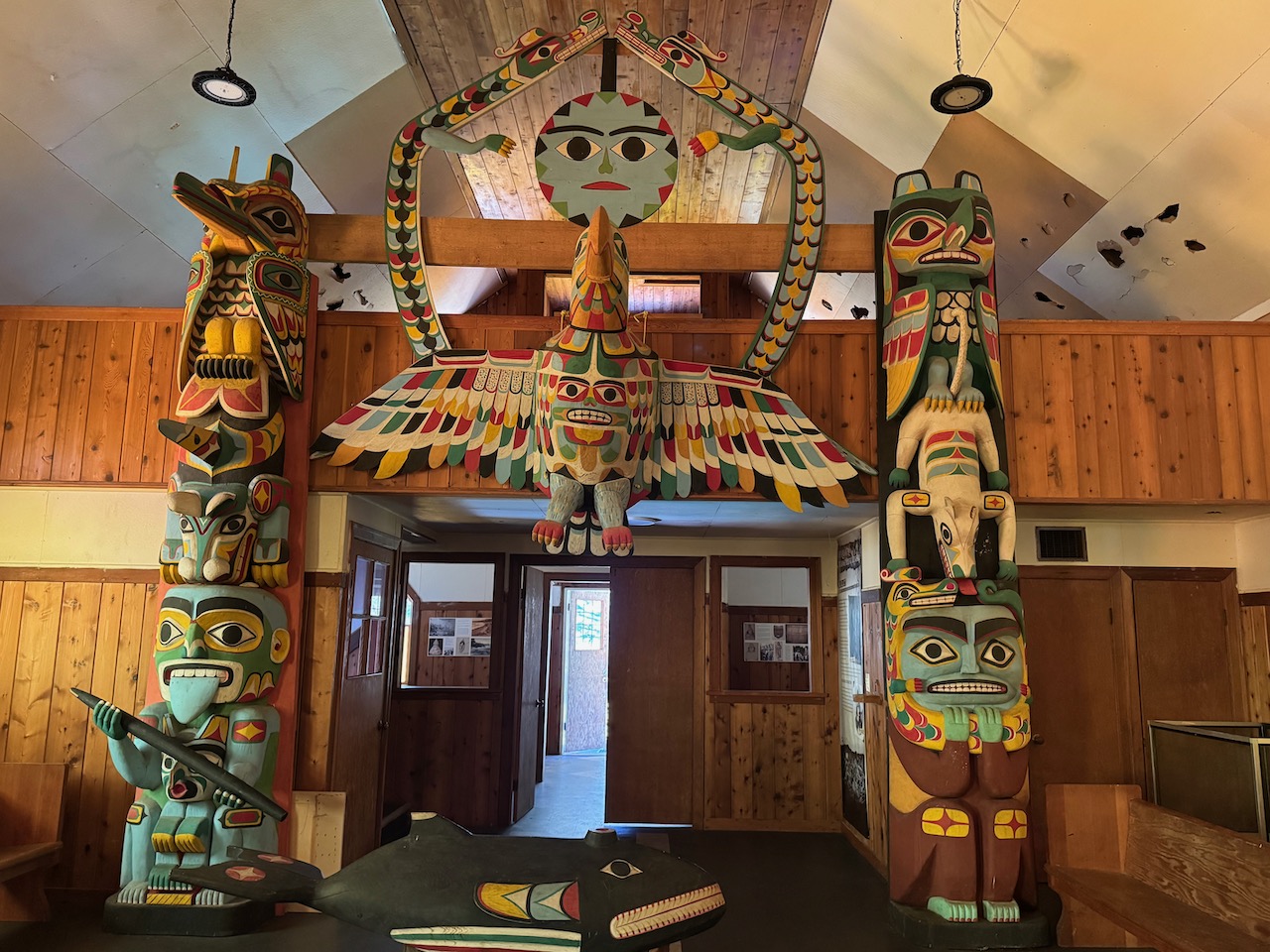
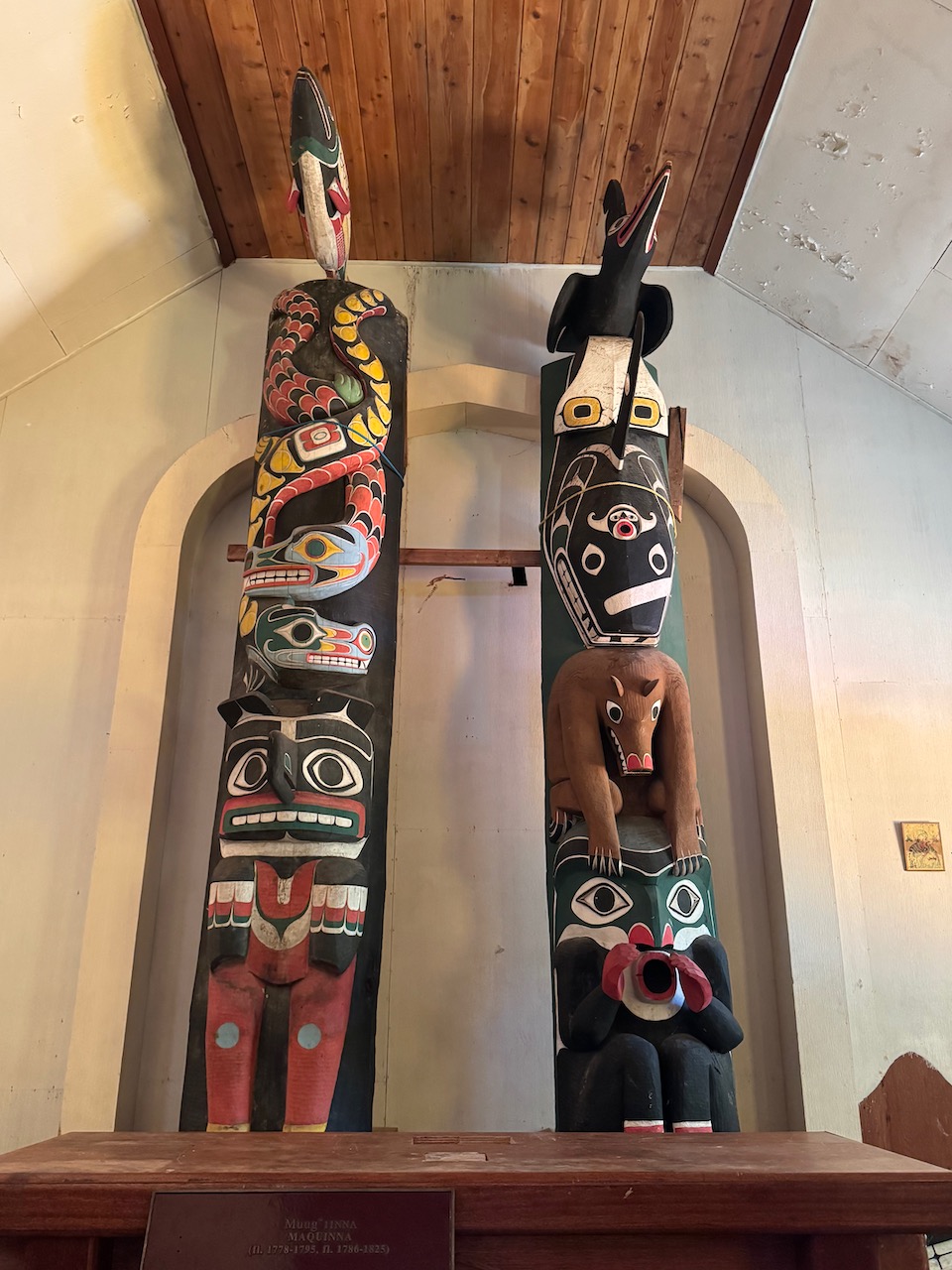
Breathtaking North Coast carvings in the historic Yuquoat Village church.
We thought we might stay one more day, but the morning broke calm and beautiful. The wind looks better tomorrow for a sail, but a gale is brewing for Saturday night. If we round our next big obstacle, Estevan Point, while it is calm, we’ll be safely tucked in if the gale strikes early. So, here we are, half-way down the West Coast of Vancouver Island tucked into Hot Springs Cove after a calm and beautiful 28-mile ocean passage. With beautiful natural hot springs this is a busy place during the day. Boatloads of tourists from Tofino—an hour away by speed boat—along with multiple float planes, have been coming in all day. But it’s almost 6PM now and the day-trippers have left. There are just three sailboats anchored in the cove. Now, is our time. I’m signing off, time to gather our things, dinghy over to the dock, and walk the 1.3-mile trail to the hot springs. Can’t wait!
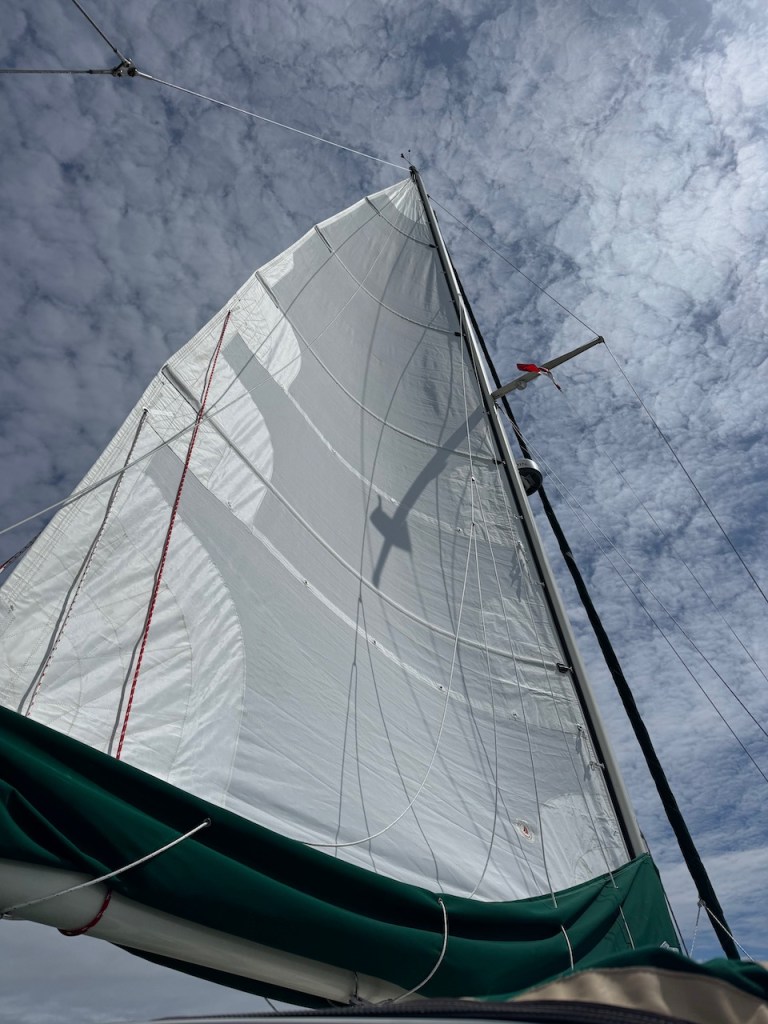
Main sail up for an easy rounding of Estevan Point.
P.S. The boardwalk hike to the hot springs is spectacularly beautiful. And the hot springs are beyond compare. Wow.
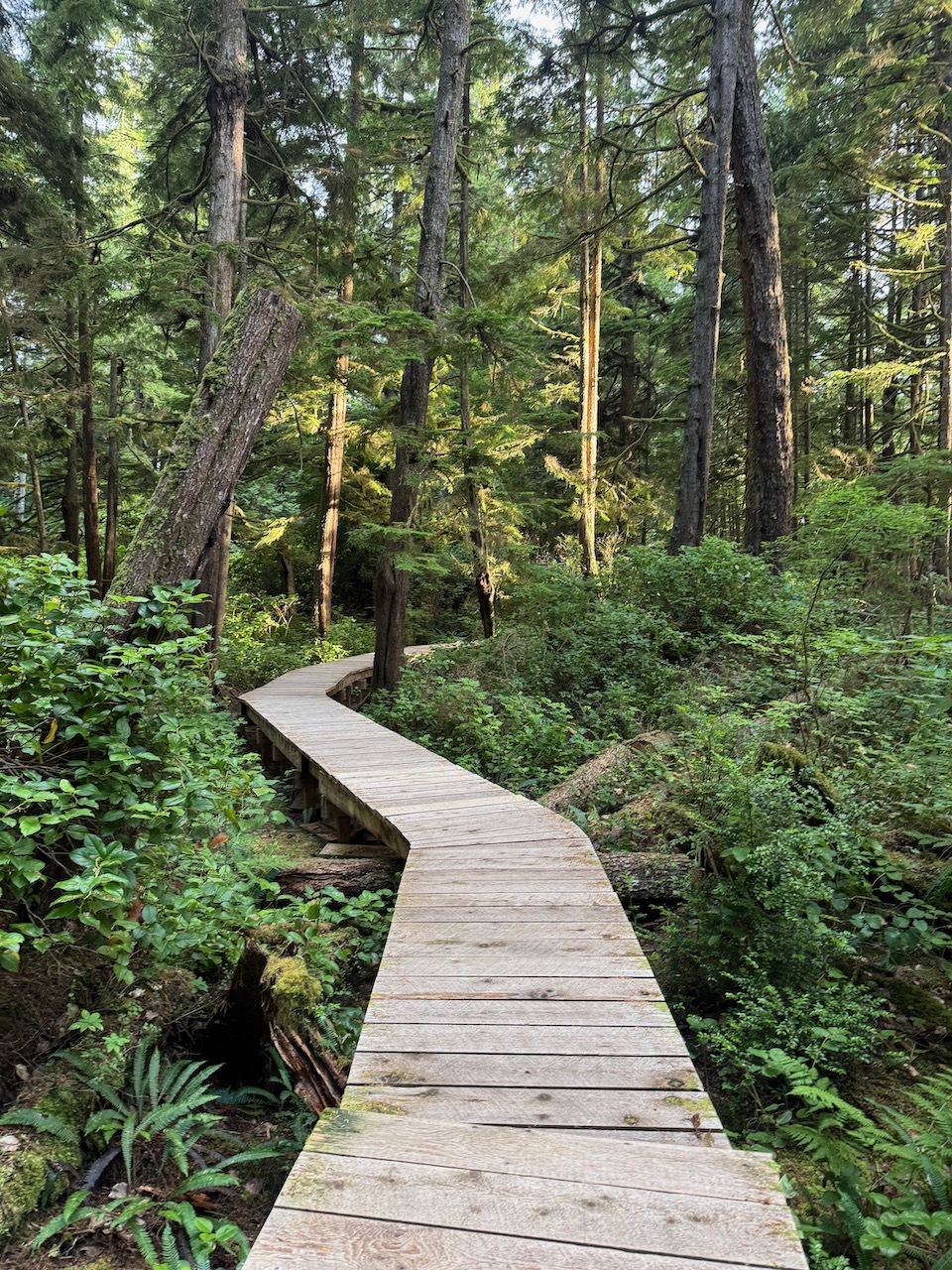
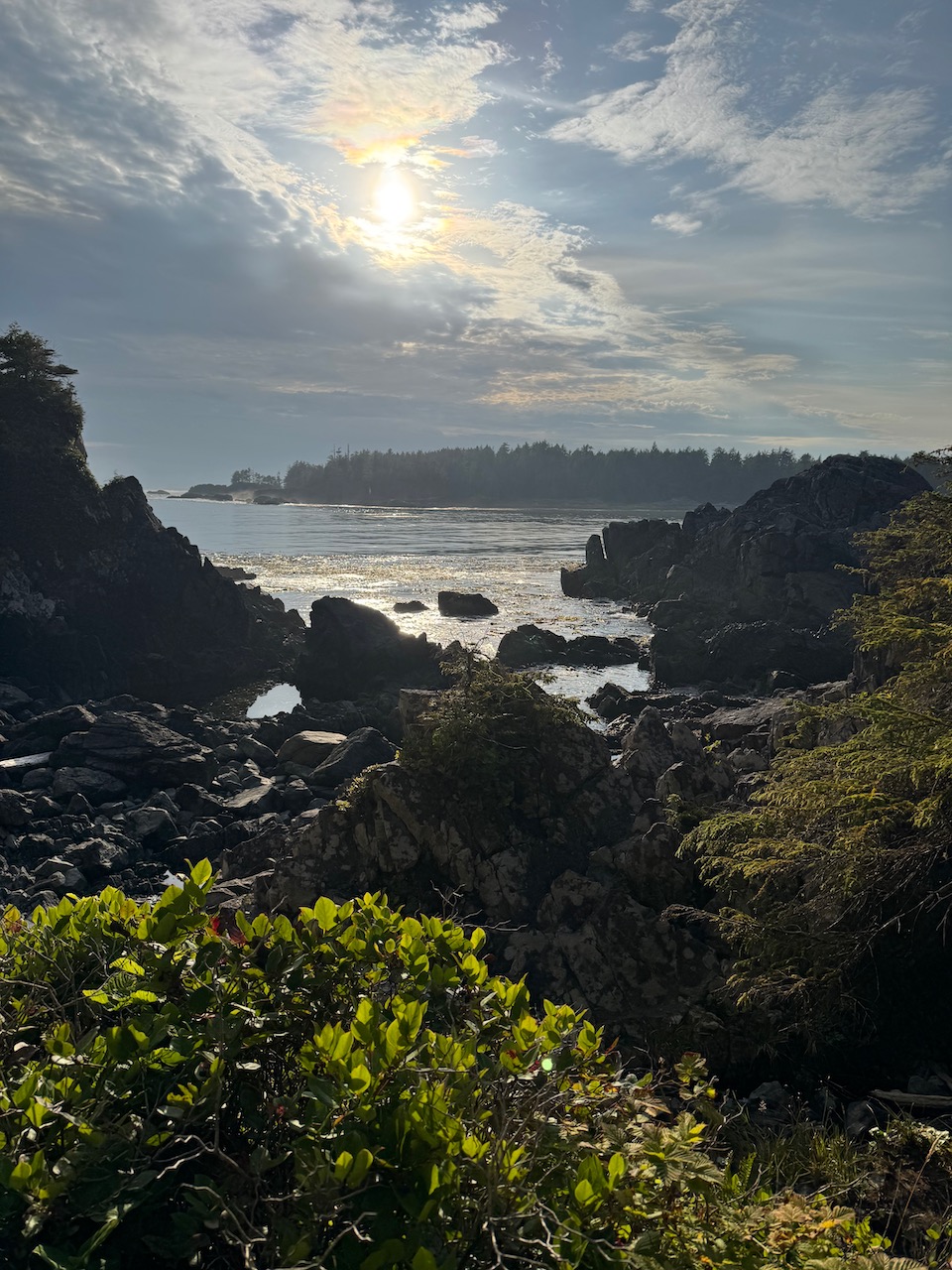
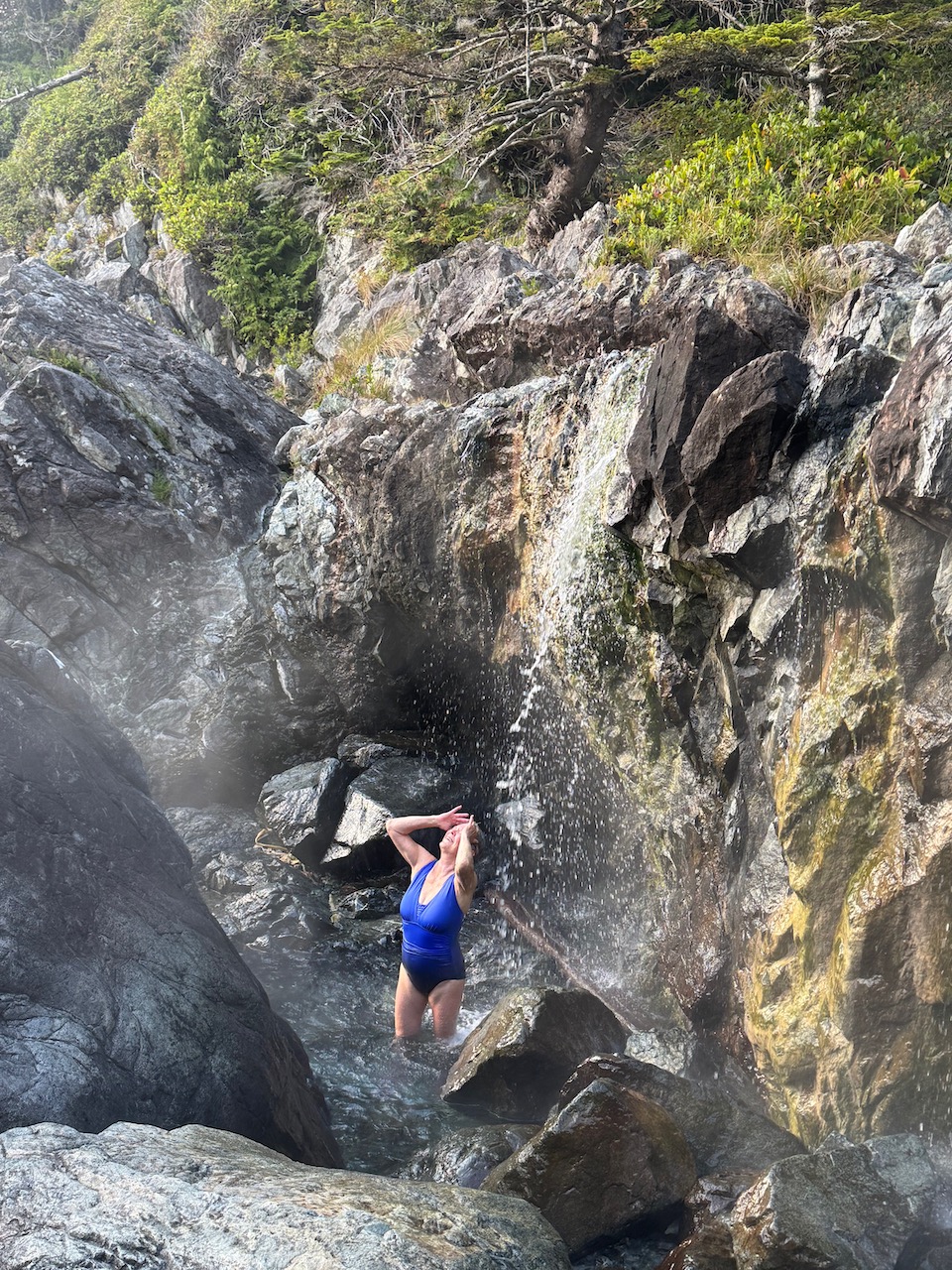
A beautiful boardwalk leads through the forest for a full mile to the hot springs, a view from the hot springs out to the ocean, Victoria enjoys a natural hot springs shower.



 Oceana Voyage
Leave a comment