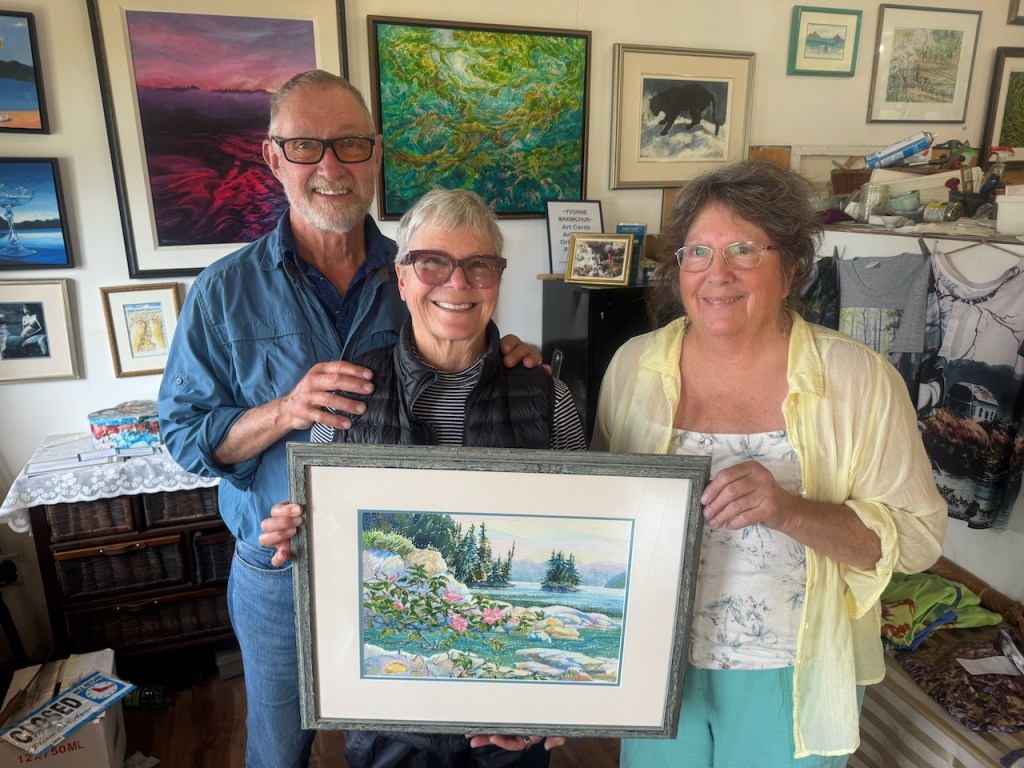
I sent Yvonne Maximchuk a text that we were in the green sailboat idling in the bay outside her house. There was an “open” sign for her gallery, Searose Studio, and a small float and ramp leading to her house, there was no other way to get there.
David and I have been reading Yvonne’s memoir, Drawn to the Sea: Paintbrush to Chainsaw—Carving Out a Life on BC’s Rugged Raincoast, and hoped we’d be able to find her gallery and meet her. So, when she responded to my text inviting us in, we were thrilled. Our sailboat is much too large to tie up at her small dock. But just around the point was Echo Bay Marina and were able to secure moorage, and then run back in our dingy to tie up to Yvonne’s dock.
We were greeted with a smile and a hug and, having read her memoir, I felt more like I was visiting an old friend than a stranger. I am in awe of this woman. Life here is far from easy, yet for 40 years she has fully committed herself to this lifestyle and her art—and excelled at both.
We took a small tour of her garden and stopped to smell her peonies and fragrant roses—then headed up to her gallery. Her work is magical and reflects the beauty she is immersed in every day. Yvonne sees it as only an artist can and masterfully works in watercolor, oil, ceramics, and textiles. We bought a painting—of course we did! Its title: “Ecstasy is a small island in June.” But the real magic of the afternoon was getting to visit with her. To be with her and hear some of her stories. To connect. What an incredible gift! Our hearts were full when we left.
Yvonne is a teacher and does art retreats at her home. How I would love to do that! She said, for example, that if she heard whales are around, we’d jump in her skiff and draw whales plein air! I’m just a little too late. Now in her 70’s—her husband is 80—they’ve realized it’s time to get closer to services they need. They’ve put this home they built—on the land they cleared—up for sale. Yvonne’s wish is that it will sell soon but not close until the end of summer—giving them one last full summer here.
When Yvonne arrived here in the mid-80s with two children in tow, it was Billy Proctor and his wife, also named Yvonne, who showed her how to navigate this watery, wet, and wild part of the BC coast. He became her teacher, mentor, grandfather to her children, and best friend. Yvonne and her husband Al built their home on land Billy subdivided and sold them. You can see Billy’s place from theirs, a quick dingy ride away.
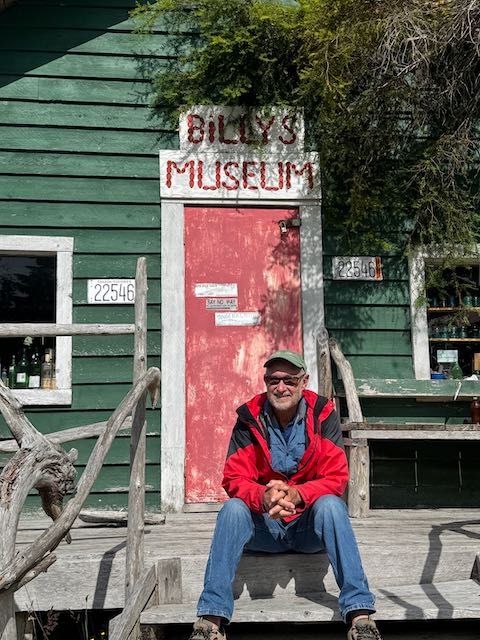
Billy Proctor is legendary in this remote part of the world. He carved a life and a living from the forest and sea—hand-logging, fishing, and building. He was bigger than life, building a museum on his property of things he’d collected, and he delighted in telling endless stories to boaters who took the trail to his museum from the small marina in Echo Bay. His memoir, Heart of the Rain Coast: A Life Story, is a Canadian national bestseller, and a must read for anyone cruising in these waters. Billy died just six weeks ago, on May 13, in his home in Echo Bay at age 90—an unfathomable loss to this tiny community, and especially for Yvonne.
We missed meeting Billy Proctor, and his museum is now closed. He left most of his property to the original owners—the Kwikwasut’inuxu Haxwa’mis First Nation people. Echo Bay Marina, was also purchased by the Kwikwasut’inuxu Haxwa’mis and they told us it’s unlikely the museum will ever reopen. The museum was more Billy’s stories than the bottles and artifacts he collected, they said, and without the stories, they just don’t see how it could be the same.
First came the loggers and fishermen, then came others as part of the back to the land movement. They built a life here and raised families here. Then large commercial fishing and logging operations replaced the owner-operator gillnetters and hand-loggers. And the generation of children raised here didn’t stay. Those left have grown old or died. There are only two family-run small marinas left. What old age and retirement didn’t take, COVID did—the loss of American boaters for two years was too much.
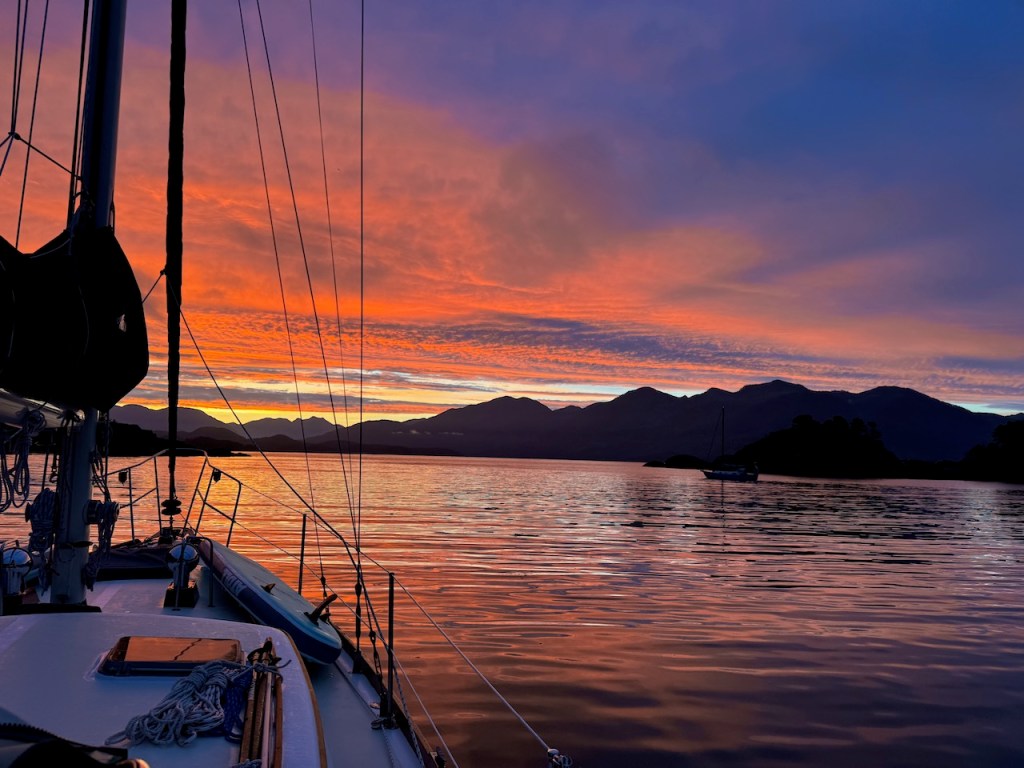
I’m writing to you from such a place now—beautiful Kwatsi Bay. David mused that being here is like being anchored in Yosemite. It was run for 24 years by Max Knierim and his wife Anka Fraser. They retired in 2021 and it was sold but never reopened. It’s sad to see a place, once run with so much love, decaying into the forest. It’s part of the circle of life, though, isn’t it?
So, there’s a little recent history of some of the white residents in this area. The native First Nation history is deep and complex. I’ll write about it in another post.
V.


 Oceana Voyage
Leave a comment